Tracing the Principles Behind Modern Diffusion Models
Diffusion models can feel like a jungle of acronyms, but the core idea is simple: start from noise and gradually move a cloud of samples until it looks like real data. This post gives an intuition-first tour showing that DDPMs, score-based models, and flow matching are the same recipe with different prediction targets, all rooted in the change-of-variable rule from calculus and powered by one shared “conditional trick” that turns learning into supervised regression. Finally, we zoom out to the speed problem and show how flow map models aim to replace many tiny denoising steps with a few big, accurate jumps toward real-time generation.
Modern diffusion models are often introduced through a long list of concepts and terms whose relationships are not immediately clear. Very quickly, one encounters names such as DDPM, SDE, ODE, probability flow, flow matching, rectified flow, distillation, consistency, flow map, together with phrases like forward process, reverse process, score, velocity field, sampler. For a reader encountering these ideas, this can be overwhelming.
In what follows, we extract the key principles behind the development of diffusion models, slow the story down, and maintain a single guiding thread throughout:
All these models describe different ways to move probability mass from “simple noise” to “complicated data”. Under the surface, they are all based on the same principle from calculus: the change-of-variable rule.
In the rest of this article, we build the picture step by step.
We begin with three common lenses on diffusion: variational-based methods (e.g., DDPM), score-based methods (e.g., Score-SDE), and flow-based methods (e.g., flow matching / rectified flow). They all follow the same basic recipe: fix a simple forward Gaussian noising process, then learn to reverse it. The main difference lies in what the network predicts, such as noise, score, or velocity.
Underneath all of them is the same math question: when we move a cloud of samples, how does the distribution change? The answer is the change-of-variable rule from Calculus applied to a particle cloud. In continuous time, this becomes the PDE view: pure transport gives the continuity equation, and transport with Gaussian jitter gives the Fokker–Planck equation. This matters because it is the bookkeeping that keeps the story honest: once we pre-specify the forward noising process, we have a specific path of snapshot distributions in mind, and the reverse-time generator must move probability mass in a way that stays consistent with that path. Without this structure, there is nothing tying the reverse-time generator to the intended transition from prior to data, so the learned dynamics can quietly drift away from the distribution evolution we had in mind.
Finally, we focus on speed. Diffusion is high fidelity but often slow because sampling is iterative. We end with flow map models, which keep the same diffusion backbone but aim to learn long time-jumps of the probability-flow dynamics directly, replacing many tiny steps with a few big, accurate jumps.
Prerequisites. This blog post may be challenging for readers who are entirely new to diffusion models. We intentionally present it as a concise roadmap that focuses only on the essential principles, offering a unified bird’s-eye view. Accordingly, we assume the reader already has a rough familiarity with diffusion models; for example, the basic idea of DDPM as a forward noising process together with learning a Gaussian denoiser.
For a more detailed introduction to the necessary background, we also provide a full PDF on our webpage: The Principles of Diffusion Models.
I. A Systematic Tour of Diffusion Models
The Generative Goal
We first discuss the goal, before introducing any technical machinery.
On the simple side, we can easily generate randomness. For example, we can draw a vector of independent Gaussian variables, which looks like pure “static”. On the complex side, we have realistic data: natural images, short audio clips, 3D shapes, and so on. These objects are high-dimensional and exhibit rich structure. A deep generative model is a procedure that maps from the simple side to the complex side. It turns noise into data.
At an abstract level, we can depict this as
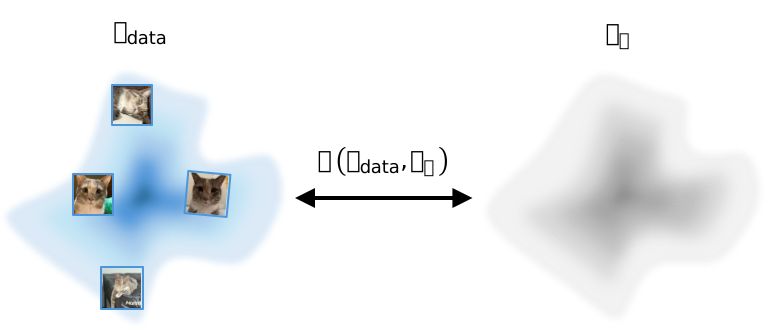
Classical models such as GANs and VAEs attempt to learn this arrow in one or a few large steps: a single neural network takes a noise vector and outputs an image.
Diffusion-style models follow a different philosophy. Instead of jumping directly from noise to data, they move in many small increments. More precisely, the construction consists of two coupled procedures:
- In the forward process, we start from real data and gradually add small amounts of simple random noise at many tiny steps. As this corruption progresses, fine details disappear first, then larger structures become indistinct, and eventually every sample looks like featureless noise. By the end, all examples, regardless of which original image or sound they came from, are brought into a common noisy space that is very close to a standard Gaussian distribution and easy to sample from. Although we typically do not run this forward process at test time, it is essential during training because it provides a precise, controlled way to relate clean data to their noisy versions.

- In the reverse process, the model learns to undo this artificial corruption step by step. Starting from pure noise, it applies a sequence of learned denoising updates that gradually reintroduce structure: coarse shapes first, then finer details. After enough steps, the final outputs resemble realistic data again. This reverse procedure is what we actually use at sampling time to turn noise into data.

In both directions, there is a common underlying object: a probability density that evolves over time. At time \(t = 0\), we may have a density that is shaped like the data distribution. As \(t\) increases, the forward process transports and blurs this density until it approaches a simple reference distribution, often called the prior. In practice, this prior is typically chosen to be a standard Gaussian, because we know how to sample from it efficiently and its properties admit closed-form expressions.
At this point, the big picture is in place: we have a simple way to corrupt data into noise, and we hope to learn a reverse procedure that undoes that corruption.
So the next step is to pin down a fully explicit forward rule that we can define ourselves: given a clean sample \(\mathbf{x}_0\), what is the distribution of its noisy version \(\mathbf{x}_t\) at each time \(t\)? Once this rule is fixed, we can talk precisely about different reverse-time modeling choices built on top of the same forward construction.
Forward Process
It helps to first make the forward noising rule completely concrete. Modern common diffusion models (such as DDPM, Score SDE, Flow Matching) that we will revisit in this post all start from this same basic construction.
Let $\mathbf{x}_0 \in \mathbb{R}^D$ be a clean data sample (an image, an audio clip, etc.) sampled from a given data distributio \(p_{\text{data}}\). The forward process gradually corrupts $\mathbf{x}_0$ into a noisy version $\mathbf{x}_t$. A standard and very convenient choice is:
\[p(\mathbf{x}_t \mid \mathbf{x}_0) = \mathcal{N}\bigl(\mathbf{x}_t;\,\alpha_t\,\mathbf{x}_0,\;\sigma_t^2\,\mathbf{I}\bigr),\]where $\alpha_t$ and $\sigma_t$ are scalar functions of the “time” $t$, and $\mathbf{I}$ is the identity matrix. Equivalently, we can sample
\[\boldsymbol{\epsilon} \sim \mathcal{N}(\mathbf{0}, \mathbf{I}), \qquad \mathbf{x}_t = \alpha_t \mathbf{x}_0 + \sigma_t \boldsymbol{\epsilon}.\]We can think of $\alpha_t$ as the amount of original signal that remains at time $t$, and $\sigma_t$ as the amount of noise that has been mixed in:
- for small $t$, $\alpha_t \approx 1$ and $\sigma_t \approx 0$, so $\mathbf{x}_t$ is close to $\mathbf{x}_0$;
- for large $t$, $\alpha_t \approx 0$ and $\sigma_t$ is large, so $\mathbf{x}_t$ is almost pure noise.
Different choices of the pair $(\alpha_t, \sigma_t)$ give rise to different noise schedules. In practice, these fall into three broad families:
-
Variance Preserving (VP): the schedules are chosen so that
\[\alpha_t^2 + \sigma_t^2 = 1\]for all $t$, meaning the total variance of $\mathbf{x}_t$ stays constant while the signal-to-noise ratio changes. Two common examples are the DDPM linear-$\beta$ schedule, where a linearly increasing noise rate $\beta(t)$ determines
\[\alpha_t = \exp\!\left(-\frac{1}{2}\int_0^t \beta(s)\,\mathrm{d}s\right),\]and the cosine schedule, where
\[\alpha_t = \cos\!\left(\frac{\pi t}{2}\right), \qquad \sigma_t = \sin\!\left(\frac{\pi t}{2}\right).\] -
Variance Exploding (VE): the signal is left untouched, \(\alpha_t = 1\), and noise is added with scale $\sigma_t$. A representative example is EDM
\[\mathbf{x}_t = \mathbf{x}_0 + t\,\boldsymbol{\epsilon}.\], which uses \(\sigma_t = t\), so that In other words, the data is never rescaled, only progressively buried under stronger noise.
-
Linear Interpolation: the simplest possible path,
\[\alpha_t = 1 - t, \qquad \sigma_t = t,\]which linearly interpolates between data and noise:
\[\mathbf{x}_t = (1-t)\mathbf{x}_0 + t\,\boldsymbol{\epsilon}.\]This is the default choice in Flow Matching and Rectified Flow.
Despite these different conventions, the forward rule is always the same one-liner, \(\mathbf{x}_t = \alpha_t \mathbf{x}_0 + \sigma_t \boldsymbol{\epsilon},\) and only the shapes of the $(\alpha_t, \sigma_t)$ curves differ. The interactive panel below lets you compare these schedules side by side and see how each one progressively corrupts the same image.
With this forward perturbation, we can view the data distribution as being “blurred” over time. The resulting time-dependent marginal density is
\[p_t(\mathbf{x}):= \int p(\mathbf{x}_t \mid \mathbf{x}_0) p_{\text{data}}(\mathbf{x}_0) \mathrm{d} \mathbf{x}_0.\]Reverse Process
Once the forward noising process is fixed, most diffusion “flavors” differ in just two choices:
- What the network predicts from \((\mathbf{x}_t, t)\), and
- How we use that prediction at sampling time to go from noise back to data.
Below we outline three widely used viewpoints that all tell the same story:
- Variational Perspective: predict the noise that was added (or, equivalently, a cleaned-up version of the sample), then use it to take one denoising step. A representative model in this family is Denoising Diffusion Probabilistic Models (DDPM).
- Score-based Perspective: predict a score function, i.e., the direction pointing toward more likely images at noise level $t$, and then follow it to move from noise back to data. The representative one Score SDE.
- Flow-based Perspective: predict a velocity (a “push”) telling how to move the sample at time \(t\), then integrate these pushes to transport noise into data. The representative example is Flow Matching.
Variational-Based Methods (e.g., DDPM): Predicting the Reverse Step via Noise or Mean
Denoising Diffusion Probabilistic Models (DDPM)
In DDPM, we work with a discrete set of noise levels, for example integer times $t=0,1,\dots,T$. The forward process gradually increases the noise so that $\mathbf{x}_T$ is approximately standard Gaussian.
Conceptually, what we would really like to know is the oracle reverse transition kernel
\[p(\mathbf{x}_{t-1}\mid \mathbf{x}_t), \qquad t=T,T-1,\dots,1,\]because then we could start from Gaussian noise $\mathbf{x}_T\sim\mathcal{N}(\mathbf{0},\mathbf{I})$ and sample backward
\[\mathbf{x}_T \to \mathbf{x}_{T-1} \to \cdots \to \mathbf{x}_0,\]until the final $\mathbf{x}_0$ looks like a real data sample.
So the learning problem seems straightforward: fit a parametric reverse kernel \(p_\theta(\mathbf{x}_{t-1}\mid \mathbf{x}_t)\) to the true one by minimizing
\[\mathbb{E}_{p_t(\mathbf{x}_t)} \big[ \mathcal{D}_{\mathrm{KL}} \big( p(\mathbf{x}_{t-1}\mid \mathbf{x}_t) \,\|\, p_\theta(\mathbf{x}_{t-1}\mid \mathbf{x}_t) \big) \big].\]But here comes the difficulty. The reverse kernel we want,
\[p(\mathbf{x}_{t-1}\mid \mathbf{x}_t),\]is not something simple we can write down directly. It is obtained by averaging over all possible clean images that might have produced the noisy sample $\mathbf{x}_t$:
\[p(\mathbf{x}_{t-1}\mid \mathbf{x}_t) = \int p(\mathbf{x}_{t-1}\mid \mathbf{x}_t,\mathbf{x}_0)\, p_{\text{data}}(\mathbf{x}_0)\, \mathrm{d}\mathbf{x}_0.\]So this marginal reverse kernel is a complicated mixture of Gaussians, and at first sight it looks hopeless to learn directly.
The key move, which we call the conditional trick, is to stop attacking this mixture head-on and instead condition on the clean image $\mathbf{x}_0$. Once we do that, the problem becomes much easier: because the forward process is Markov and Gaussian, the conditional reverse kernel
\[p(\mathbf{x}_{t-1}\mid \mathbf{x}_t,\mathbf{x}_0)\]is itself just a single Gaussian with a closed-form mean and variance.
A neat calculation then shows that the original “impossible” objective can be rewritten as
where $C$ is a constant independent of $\theta$.
In words, instead of matching the unknown mixture \(p(\mathbf{x}_{t-1}\mid \mathbf{x}_t)\) directly, we match the much simpler Gaussian conditional \(p(\mathbf{x}_{t-1}\mid \mathbf{x}_t,\mathbf{x}_0)\) for random training examples $\mathbf{x}_0$. This new target is fully tractable, yet it is still equivalent to the original KL objective up to a constant.
This conditional trick is one of the most important recurring ideas in diffusion-type models. It will show up again in score-based SDEs and in flow matching / rectified flow: in each case, conditioning on $\mathbf{x}_0$ turns an intractable object into a regression target we can actually learn.
Because the forward noising rule is linear and Gaussian, the one-step reverse transition also has a convenient Gaussian form. So DDPM models the reverse kernel as
\[p_\theta(\mathbf{x}_{t-1}\mid \mathbf{x}_t) := \mathcal{N}\!\big(\boldsymbol{\mu}_\theta(\mathbf{x}_t,t),\,\tilde{\sigma}_t^2\mathbf{I}\big).\]Here \(\tilde{\sigma}_t^2\) is a known, pre-chosen variance, so the only learnable part is the mean \(\boldsymbol{\mu}_\theta(\mathbf{x}_t,t)\).
At this point, one might think the network should simply predict this mean directly. But in practice, DDPM usually takes a more clever route.
The reason is closely tied to the conditional trick above. Once the clean image $\mathbf{x}_0$ is known, the correct reverse Gaussian is easy to write down. In other words, if we knew $\mathbf{x}_0$, then the reverse step would no longer be mysterious. For a general linear forward rule
\[\mathbf{x}_t=\alpha_t\mathbf{x}_0+\sigma_t\boldsymbol{\epsilon}, \qquad \boldsymbol{\epsilon}\sim\mathcal{N}(\mathbf{0},\mathbf{I}),\]the conditional reverse mean is an explicit analytic function of the current noisy sample $\mathbf{x}_t$ and the clean image $\mathbf{x}_0$. This is what is meant by the “closed-form reverse formula.”
So the remaining question is: if we do not know $\mathbf{x}_0$, what should the network predict instead?
The forward relation above gives a very natural answer. It says that $\mathbf{x}_t$ is obtained by mixing the clean image $\mathbf{x}_0$ with Gaussian noise $\boldsymbol{\epsilon}$. So knowing $\mathbf{x}_0$ and knowing $\boldsymbol{\epsilon}$ are essentially two sides of the same coin: from one, we can recover the other.
This is why DDPM often asks the network to predict the added noise rather than the reverse mean itself. If the network outputs a noise estimate $\boldsymbol{\epsilon}_\theta(\mathbf{x}_t,t)$, then we can immediately turn it into an estimate of the clean image:
\[\widehat{\mathbf{x}}_0 = \frac{\mathbf{x}_t-\sigma_t\,\boldsymbol{\epsilon}_\theta(\mathbf{x}_t,t)}{\alpha_t}.\]And once we have this estimated clean image, we simply plug it into the analytic reverse formula to obtain the Gaussian mean for the reverse step:
\[\boldsymbol{\mu}_\theta(\mathbf{x}_t,t) := \tilde{\boldsymbol{\mu}}_t\!\big(\mathbf{x}_t,\widehat{\mathbf{x}}_0\big).\]So the logic is very clean:
- if $\mathbf{x}_0$ were known, the reverse mean would be easy to compute;
- predicting the noise lets us reconstruct $\widehat{\mathbf{x}}_0$;
- and from $\widehat{\mathbf{x}}_0$ we recover the reverse mean.
In this sense, the network is not really bypassing the reverse mean. Instead, it reaches that reverse mean through an easier intermediate target, namely the added noise. In the original DDPM formulation, one therefore trains $\boldsymbol{\epsilon}_\theta(\mathbf{x}_t,t)$ with the regression objective
\[\mathcal{L}_{\text{variational}}(\theta) = \mathbb{E}_{t,\,\mathbf{x}_0,\,\boldsymbol{\epsilon}} \Big[ \lambda(t)\, \big\| \boldsymbol{\epsilon}_\theta(\mathbf{x}_t,t)-\boldsymbol{\epsilon} \big\|_2^2 \Big],\]where $\lambda(t)$ is a time-dependent weight.
Intuitively, the network sees a noisy sample $\mathbf{x}_t$ together with its noise level $t$, and learns to answer: “What noise was added to create this sample?” But the same learning problem can also be written in an equivalent clean-prediction form. From that viewpoint, the question becomes: “Given this noisy observation, what is the best estimate of the clean sample from which it was constructed?”
At sampling time, we start from the terminal Gaussian state $p_T$, which in standard DDPM is chosen to be close to $\mathcal{N}(\mathbf{0},\mathbf{I})$. Then, at each reverse step, we
- predict the noise $\boldsymbol{\epsilon}_\theta(\mathbf{x}_t,t)$,
- convert it into a clean-image estimate $\widehat{\mathbf{x}}_0$,
- use the closed-form reverse formula to obtain the Gaussian mean $\boldsymbol{\mu}_\theta(\mathbf{x}_t,t)$,
- sample $\mathbf{x}_{t-1}$.
Repeating this from $t=T$ down to $t=1$ gradually turns Gaussian noise into a clean sample $\mathbf{x}_0$.
So even though DDPM is often described as “predicting noise”, the deeper story is slightly richer: the model predicts noise because noise prediction gives a simple route to the clean image, and the clean image gives a simple route to the reverse Gaussian step.
Score-Based Methods: Predict the Score
Score-based diffusion models
where \(p_t\) is the marginal density of noisy samples at time \(t\). Intuitively, the score is a local arrow field: at each point \(\mathbf{x}\), it points toward directions where samples are more likely under \(p_t\).
To see why this object appears so naturally, it is helpful to start from the continuous-time view originally proposed in Score-SDE
This expression summarizes the accumulated effect of noising up to time \(t\): part of the original signal is retained through \(\alpha_t\), while Gaussian noise is injected with total scale \(\sigma_t\).
The same process can also be described locally in time. Over an infinitesimal interval \(\mathrm{d}t\), the current sample is first slightly drifted and then receives a tiny Gaussian perturbation:
\[\mathbf{x}_{t+\mathrm{d}t} \approx \mathbf{x}_t + f(t)\mathbf{x}_t\,\mathrm{d}t + g(t)\sqrt{\mathrm{d}t}\,\mathbf{z}, \qquad \mathbf{z}\sim\mathcal{N}(\mathbf{0},\mathbf{I}).\]So here \(f(t)\) and \(g(t)\) describe what happens moment by moment: \(f(t)\) controls the infinitesimal drift, while \(g(t)\) controls the infinitesimal noise injection.
These local coefficients are tied to the accumulated coefficients \(\alpha_t\) and \(\sigma_t\). In words, they are obtained by differentiating the accumulated signal-and-noise levels and matching them with the infinitesimal update above. This gives
\[f(t)=\frac{\mathrm{d}}{\mathrm{d}t}\log\alpha_t=\frac{\dot{\alpha}_t}{\alpha_t}, \qquad g^2(t)=\frac{\mathrm{d}}{\mathrm{d}t}\sigma_t^2-2f(t)\sigma_t^2.\]When we take the continuous-time limit, the infinitesimal update becomes the forward stochastic differential equation
\[\mathrm{d}\mathbf{x}_t = f(t)\mathbf{x}_t\,\mathrm{d}t + g(t)\,\mathrm{d}\mathbf{w}_t,\]where $\mathbf{w}_t$ is a Wiener process. Intuitively, over a small time step $\Delta t$, its increment is Gaussian:
\[\mathbf{w}_{t+\Delta t}-\mathbf{w}_t \sim \mathcal{N}(\mathbf{0},\, \Delta t\,\mathbf{I}).\]Heuristically, this is often written in differential form as
\[\mathrm{d}\mathbf{w}_t \sim \mathcal{N}(\mathbf{0},\, \mathrm{d}t\,\mathbf{I}).\]In this sense, a Wiener process can be viewed as the continuous-time limit of accumulating infinitely many infinitesimal Gaussian perturbations.
So the global perturbation formula
\[\mathbf{x}_t=\alpha_t\mathbf{x}_0+\sigma_t\boldsymbol{\epsilon}\]and the local SDE description are just two equivalent views of the same forward noising process: one records the total effect up to time \(t\), while the other records what happens moment by moment.
Once this forward process is fixed, it anchors the whole family of noisy marginals \(p_t\). A classical result of Anderson
And this is exactly where the score \(\nabla_{\mathbf{x}}\log p_t(\mathbf{x}_t)\) shows up! It is not inserted by hand. It appears naturally as the correction term that makes the backward dynamics follow the same family of marginals \(p_t\), now traversed in reverse from noise to data.
Of course, this immediately creates a new learning problem: the true score \(\nabla_{\mathbf{x}}\log p_t(\mathbf{x})\) depends on the unknown marginal density \(p_t\), so we still cannot compute it directly.
At this point, the same conditional trick we saw in DDPM shows up again, now under its earlier and classical name: denoising score matching
Since \(\mathbf{x}_t=\alpha_t\mathbf{x}_0+\sigma_t\boldsymbol{\epsilon},\) this is equivalently
\[-\frac{1}{\sigma_t}\boldsymbol{\epsilon}.\]So the supervision becomes very concrete: given a noisy sample, predict the direction that removes the injected noise.
Training is then just a regression problem. We sample \(\mathbf{x}_0\), choose \(t\), draw \(\boldsymbol{\epsilon}\sim\mathcal{N}(\mathbf{0},\mathbf{I})\), form \(\mathbf{x}_t\), and minimize the denoising score matching loss
\[\mathcal{L}_{\text{score}}(\theta) = \mathbb{E}_{t,\,\mathbf{x}_0,\,\boldsymbol{\epsilon}} \Big[ \lambda(t)\, \big\| \mathbf{s}_\theta(\mathbf{x}_t,t) +\frac{1}{\sigma_t^2}\bigl(\mathbf{x}_t-\alpha_t\mathbf{x}_0\bigr) \big\|_2^2 \Big].\]More precisely, denoising score matching says that the intractable regression target \(\nabla_{\mathbf{x}_t}\log p_t(\mathbf{x}_t)\) can be replaced by the tractable conditional target \(\nabla_{\mathbf{x}_t}\log p(\mathbf{x}_t\mid \mathbf{x}_0),\) and the two objectives differ only by a constant. So they give the same optimum and the same learning signal. Formally, for a constant \(C\) independent of \(\theta\),
Once the score network \(\mathbf{s}_\theta\) has been learned, it can be plugged back into the reverse-time dynamics for generation. One option is to sample from the reverse-time SDE itself:
\[\mathrm{d}\mathbf{x}_t = \Big[ f(t)\mathbf{x}_t - g^2(t)\mathbf{s}_\theta(\mathbf{x}_t,t) \Big]\mathrm{d}t + g(t)\,\mathrm{d}\bar{\mathbf{w}}_t.\]Starting from a draw from the prior, we can solve this stochastic equation backward from large noise to small noise and eventually obtain a data-like sample.
A particularly clean alternative is the probability-flow ODE (PF-ODE), which gives a deterministic trajectory from noise to data:
\[\frac{\mathrm{d}\mathbf{x}(t)}{\mathrm{d}t} = f(t)\mathbf{x}(t) -\frac{1}{2}g^2(t)\mathbf{s}_\theta(\mathbf{x}(t),t).\]Starting from a seed drawn from the prior, \(\mathbf{x}_T\sim p_{\text{prior}}\), we numerically integrate this ODE backward from \(t=T\) to \(t=0\). The endpoint \(\mathbf{x}_0\) is then a data-like sample.
The reverse-time SDE and the PF-ODE look very similar, and this is not an accident. Both are constructed so that, at every time \(t\), their marginal distribution matches the same family \(p_t\). In other words, they pass through the same sequence of “distribution snapshots” over time. Later, we will see that this is guaranteed by the Fokker–Planck equation, which can be viewed as a noise-involved analogue of the change-of-variable formula. Their difference lies in the nature of the trajectory. The reverse-time SDE remains stochastic, whereas the PF-ODE is fully deterministic. Removing the random term is exactly why the PF-ODE carries an extra factor of \(1/2\) in front of the score term.
One subtle point is worth emphasizing. The reverse-time SDE should not be understood as simply taking a sample path from the forward SDE and playing the movie backward. For stochastic processes, time reversal is more delicate: the backward dynamics is itself a different SDE, with a score-corrected drift chosen so that the marginals evolve through the same family \(p_t\), but now in reverse. The PF-ODE is different. Because it is deterministic, once its vector field is defined, we can integrate it either forward in time from data to noise or backward in time from noise to data. So for the ODE, these really are two directions of the same flow. So the clean picture is this: the forward SDE and the reverse-time SDE are two related but different stochastic processes that share the same marginal family \(p_t\) in opposite time directions, whereas the PF-ODE is a single deterministic flow that can be solved in either direction while matching those same marginal snapshots \(p_t\).
This change of viewpoint is one of the most important shifts from DDPM to Score-SDE. The generation process is no longer described mainly as repeatedly applying discrete denoising steps; instead, it becomes the problem of solving a time-dependent differential equation. That opens the door to the rich literature on numerical ODE/SDE solvers, which can be used to design faster samplers. At the same time, this viewpoint makes one limitation very transparent: diffusion sampling is inherently iterative. Whether we solve the reverse-time SDE or the PF-ODE, generation proceeds through many small updates across time. For high-dimensional data, good sample quality often requires many such steps, which is one major reason why standard diffusion models can be slow at test time.
In modern practice, people often prefer working with the PF-ODE rather than the reverse-time SDE. The main reason is that the PF-ODE is deterministic, so it avoids the extra stochastic term and is usually simpler to integrate numerically. This makes it easier to leverage the rich classical literature on ODE solvers, and also easier to build fast acceleration methods such as distillation and flow-map-style samplers, which we will revisit later. That said, reverse-time SDE samplers remain important in the literature and can sometimes offer advantages in sample quality or robustness, so this preference is practical rather than absolute.
The Score-SDE framework can therefore be viewed as a continuous-time extension of DDPM. It keeps the same noising idea, but expresses both training and generation in the language of differential equations. We will revisit this viewpoint again when introducing Flow Matching below, where the notation becomes even cleaner.
Flow-Based Method (e.g., Flow Matching): Predict the Velocity
In score-based diffusion, we first learn a score \(\mathbf{s}_\theta(\mathbf{x},t)\) (a “which way is more likely” direction), and then convert it into a sampler by integrating the PF-ODE. Flow Matching
We start from the same linear-Gaussian coupling between clean data and noisy data: \(\mathbf{x}_t=\alpha_t\mathbf{x}_0+\sigma_t\boldsymbol{\epsilon}\), with \(\boldsymbol{\epsilon}\sim\mathcal{N}(\mathbf{0},\mathbf{I})\). If we imagine following this path as \(t\) changes, the instantaneous motion is just its time derivative:
\[\mathbf{v}^{\text{cond}}(\mathbf{x}_t,t) := \dot{\mathbf{x}}_t = \dot{\alpha}_t\,\mathbf{x}_0+\dot{\sigma}_t\,\boldsymbol{\epsilon}.\]This is the familiar conditional trick: although we do not know the “true” marginal velocity associated with \(p_t\), conditioning on \(\mathbf{x}_0\) gives a closed-form regression target.
Training is therefore a simple regression problem. We sample \(\mathbf{x}_0,t,\boldsymbol{\epsilon}\), form \(\mathbf{x}_t\), and fit \(\mathbf{v}_\theta(\mathbf{x}_t,t)\) to match \(\dot{\alpha}_t\mathbf{x}_0+\dot{\sigma}_t\boldsymbol{\epsilon}\):
\[\mathcal{L}_{\text{FM}}(\theta) = \mathbb{E}_{t,\,\mathbf{x}_0,\,\boldsymbol{\epsilon}} \Big[ \lambda(t)\, \big\| \mathbf{v}_\theta(\mathbf{x}_t,t) - (\dot{\alpha}_t\,\mathbf{x}_0+\dot{\sigma}_t\,\boldsymbol{\epsilon}) \big\|_2^2 \Big].\]The only subtlety is what the “right” target is if our network only gets \(\mathbf{x}_t\). At time \(t\), many different clean images \(\mathbf{x}_0\) can lead to the same noisy point \(\mathbf{x}_t\), so \(\mathbf{v}^{\text{cond}}(\mathbf{x}_t,t)\) is not a single-valued function of \(\mathbf{x}_t\) alone. In squared error, the best possible predictor given only \(\mathbf{x}_t\) is the conditional mean of the target, under the chosen marginal path \(p_t\):
\[\mathbf{v}(\mathbf{x}, t) := \mathbb{E}\!\left[\mathbf{v}^{\text{cond}}(\mathbf{x}_t, t)\,\middle|\,\mathbf{x}_t=\mathbf{x}\right], \qquad \mathbf{x}_t\sim p_t.\]Now the key equivalence mirrors denoising score matching. A standard squared-loss decomposition implies that, for a constant \(C\) independent of \(\theta\),
Namely, we rewrite the objective so we can swap an unknown marginal target for a tractable conditional one. The two losses differ only by a constant (independent of \(\theta\)), so they induce the same gradient updates and share the same optimum.
Before we move on, we stress one subtle but important point. In Flow Matching and Rectified Flow, the noise scheduler choice is
\[\mathbf{x}_t = (1-t)\,\mathbf{x}_0 + t\,\boldsymbol{\epsilon}\]means that, for a fixed pair $(\mathbf{x}_0, \boldsymbol{\epsilon})$, the sample travels along a perfectly straight line from data to noise. In other words, the conditional path is linear, and the conditional velocity is just the constant $\boldsymbol{\epsilon} - \mathbf{x}_0$, pointing from $\mathbf{x}_0$ toward $\boldsymbol{\epsilon}$.
However, this does NOT mean that the marginal velocity field $\mathbf{v}(\mathbf{x},t)$ — the one the sampler actually follows — is also simple. The marginal velocity at $(\mathbf{x},t)$ is obtained by averaging the conditional velocity over all data–noise pairs $(\mathbf{x}_0, \boldsymbol{\epsilon})$ that could have produced $\mathbf{x}$ at time $t$:
\[\mathbf{v}(\mathbf{x},t) = \mathbb{E}\!\left[\boldsymbol{\epsilon}-\mathbf{x}_0 \;\middle|\; \mathbf{x}_t = \mathbf{x}\right].\]This average is a nonlinear function of $\mathbf{x}$ that changes with $t$. As a result, the ODE trajectories defined by $\mathbf{v}$ can be highly curved, even though every underlying conditional path is straight. The interactive panel below makes this concrete: with data at just two points $\pm\mu$, the gray conditional paths are all straight lines, but the red ODE trajectories (which a sampler would actually follow) curve dramatically as they “decide” which mode to route toward.
The takeaway: “linear interpolation” describes the motion of individual coupled samples, not the evolution of the full probability distribution. A linear noise schedule does not straighten the ODE trajectories, so it does not, on its own, guarantee fast sampling with fewer solver steps.
At test time, we sample \(\mathbf{x}_T\sim\mathcal{N}(\mathbf{0},\mathbf{I})\) and integrate the learned ODE
\[\frac{\mathrm{d}\mathbf{x}(t)}{\mathrm{d}t}=\mathbf{v}_\theta(\mathbf{x}(t),t), \qquad t:T\to 0,\]to obtain a data-like \(\mathbf{x}_0\). To actually run this on a computer, we discretize time into a grid and step backward from \(t\) to \(t-\Delta t\) along a chosen schedule. Each step replaces the continuous ODE with a small update rule, giving a practical approximation to the trajectory. Below are two standard concrete examples.
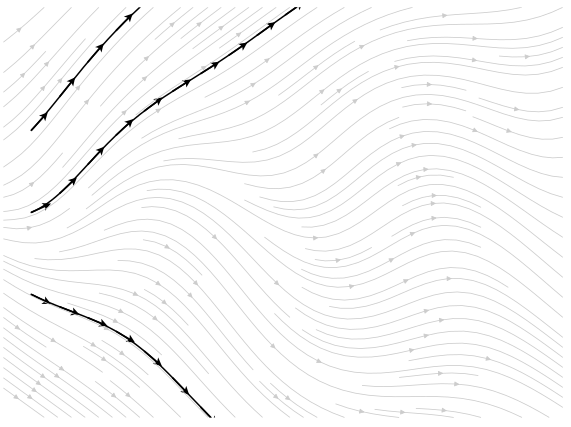
Euler = DDIM-style Step
The simplest choice is to use the velocity at the current point:
\[\mathbf{x}_{t-\Delta t} = \mathbf{x}_t -\Delta t\,\mathbf{v}_\theta(\mathbf{x}_t,t).\]This is the basic first-order Euler discretization of an ODE. When the learned diffusion-model velocity is plugged in, the update recovers the familiar DDIM-style deterministic sampler
In that case, it is more accurately interpreted as an exponential-Euler scheme. See Section 9.6 of
Heun = 2nd-order DPM-Solver-style Step
A small upgrade is to take one “draft” step, then correct it using the velocity at the endpoint.
Predict (Euler):
\[\tilde{\mathbf{x}}_{t-\Delta t} = \mathbf{x}_t-\Delta t\,\mathbf{v}_\theta(\mathbf{x}_t,t).\]Correct (average the two velocities):
\[\mathbf{x}_{t-\Delta t} = \mathbf{x}_t -\frac{\Delta t}{2}\Big( \mathbf{v}_\theta(\mathbf{x}_t,t) + \mathbf{v}_\theta(\tilde{\mathbf{x}}_{t-\Delta t},\,t-\Delta t) \Big).\]This is a second-order method. With the diffusion-model velocity plugged in, it becomes the same predictor–corrector pattern used by second-order DPM-Solver variants
In both cases, repeating the update from \(t=T\) down to \(t=0\) yields a data-like sample \(\mathbf{x}_0\).
Three Lenses on the Same Diffusion Path
With the same fixed forward Gaussian rule \(\mathbf{x}_t = \alpha_t \mathbf{x}_0 + \sigma_t \boldsymbol{\epsilon},\) all these methods start from the same convenience: we can generate a noisy sample \(\mathbf{x}_t\) from a clean sample \(\mathbf{x}_0\) in a fully analytic way. What changes is which learnable target we use to describe (and later reverse) the evolution of the noisy marginals \(p_t\):
- DDPM: predict the noise that was added (equivalently, a denoising direction / mean for one reverse step).
- Score SDE: predict the score, a direction that points toward more likely samples under \(p_t\).
- Flow matching: predict a velocity, the instantaneous “push” that transports samples along the path.
Despite these different targets, the training recipe follows the same principle: we avoid regressing on an intractable marginal object directly. Instead, we use the known conditional \(p(\mathbf{x}_t\mid \mathbf{x}_0)\) to build a closed-form conditional target (noise / conditional score / conditional velocity). This is the same conditional trick, just shown in different forms.
Indeed, these targets (\(\mathbf{x}\)- / \(\boldsymbol{\epsilon}\)- / score- / velocity-prediction) are not isolated choices. They are different parameterizations of the same underlying Gaussian path. For instance, the forward rule \(\mathbf{x}_t=\alpha_t\mathbf{x}_0+\sigma_t\boldsymbol{\epsilon}\) links \(\mathbf{x}_0\) and \(\boldsymbol{\epsilon}\) analytically, so knowing one lets you recover the others. As a result, the same reverse-step mean can be written using any of these parameterizations.
Likewise, under the same marginal path \(p_t\), the “oracle” velocity that transports \(p_t\) is tied to the score via the PF-ODE identity
\[\mathbf{v}(\mathbf{x},t)=f(t)\mathbf{x}-\frac{1}{2}g^2(t)\mathbf{s}(\mathbf{x},t).\]So, while different papers choose different training targets, they are largely inter-convertible descriptions of the same density evolution.
Next, we connect this back to the calculus view: how a distribution \(p_t\) changes when we move points (ODE) or add randomness (diffusion).
II. Change-of-Variable Formulas
All the forward and reverse procedures above can be viewed through the same geometric lens: we draw many points from some distribution (data, or the prior) and then move those points together according to a rule. If we imagine these points as a cloud in space, moving every point deforms the cloud: some regions get more crowded, others become more sparse.
This immediately raises a recurring question:
In diffusion models, what happens to the underlying probability density when we move (and sometimes randomly perturb) all points, from the data distribution toward the prior, or back again?
The first step toward a precise answer is a familiar tool from calculus: the change-of-variable formula.
The Intuition: A Particle Cloud
Imagine every possible image or audio clip is a point \(\mathbf{x}\in\mathbb{R}^D\). Place a tiny particle at each data sample. Where particles cluster, the density is high; where they rarely appear, the density is low.
Now imagine applying a transformation to every particle. The key invariant is mass conservation: particles move around, but they are not created or destroyed, so total probability stays 1. Density changes only because space is stretched or squeezed.
Everything below is just different ways to write this idea cleanly.
The Math We Already Know
The good news is that diffusion models do not require exotic math. They mostly reuse one idea from calculus: if we move points, we automatically change how density concentrates. Let us start with the simplest case.
Calculus 101 (One Dimension)
Let \(x_0\in\mathbb{R}\) be a random variable with density \(p_0(x_0)\). Apply a smooth invertible map \(\Psi:\mathbb{R}\to\mathbb{R}\) and define \(x_1=\Psi(x_0).\) Then the density after the map is
\[p_1(x_1) = p_0\bigl(\Psi^{-1}(x_1)\bigr)\, \left|\frac{\mathrm{d}\Psi^{-1}}{\mathrm{d} x_1}\right|.\]Intuitively, \(\Psi\) can squeeze or stretch the line. If it squeezes many \(x_0\) values into a small interval of \(x_1\), the density must go up there. If it stretches space out, density must go down. The factor \(\left|\frac{\mathrm{d}\Psi^{-1}}{\mathrm{d} x_1}\right|\) is exactly this local stretching ratio.
Higher Dimensions (and Why the Continuity Equation Is the Same Idea)
In \(\mathbb{R}^D\), the change-of-variables rule looks scarier only because of the determinant. Let \(\Psi:\mathbb{R}^D\to\mathbb{R}^D\) be a smooth bijection and set \(\mathbf{x}_1=\Psi(\mathbf{x}_0)\). If \(p_0\) is the density before the map and \(p_1\) after, then
\[p_1(\mathbf{x}_1) = p_0\bigl(\Psi^{-1}(\mathbf{x}_1)\bigr)\, \left|\det\frac{\partial \Psi^{-1}}{\partial \mathbf{x}_1}\right|.\]The determinant is just a local volume scale: if a tiny ball of points gets stretched to have 2× the volume, then the density must drop by 2× so that mass stays the same.
The takeaway we will keep using is:
If we move points by an invertible map, density changes according to how much the map locally stretches or compresses space.

From One Big Map to a Time-Evolution
The change-of-variable formula tells us how one invertible map \(\Psi\) reshapes a density by locally stretches or compresses volume.
To get to diffusion-style dynamics, we simply stop doing one big warp and instead apply many tiny warps in sequence. Think of a long chain of bijections:
\[\mathbf{x}_0 \xrightarrow{\ \Psi_1\ } \mathbf{x}_{\Delta t} \xrightarrow{\ \Psi_2\ } \mathbf{x}_{2\Delta t} \ \cdots\ \xrightarrow{\ \Psi_L\ } \mathbf{x}_{T}, \qquad \Delta t = T/L.\]Each step conserves probability mass and therefore obeys the same change-of-variable rule. In log form, the Jacobian determinants just add up:
\[\log p_T(\mathbf{x}_T) = \log p_0(\mathbf{x}_0) - \sum_{k=1}^L \log\left|\det\frac{\partial \Psi_k}{\partial \mathbf{x}}\right|.\]This is exactly the normalizing-flow picture, only used in tiny increments.
Now make those increments concrete with a nice set of illustration. A natural “tiny warp” is to move each point a small distance along a velocity field,
\[\mathbf{x}_{t+\Delta t}=\mathbf{x}_t+\Delta t\,\mathbf{v}_t(\mathbf{x}_t),\]or we write it as:
\[\Psi_{\Delta t}(\mathbf{x}):=\mathbf{x}+\Delta t\,\mathbf{v}_t(\mathbf{x}).\]To understand how the density changes, keep one picture in mind: \(p_{t+\Delta t}(\mathbf{x})\) measures how much probability mass ends up near \(\mathbf{x}\) after the step.
Change-of-variables says this comes from two first-order effects happening at once. First, the mass near \(\mathbf{x}\) must have arrived from a nearby point at time \(t\), namely the point that maps into \(\mathbf{x}\) under one step. Since the step is tiny, this “backtracked” location is simply
\[\Psi_{\Delta t}^{-1}(\mathbf{x}) = \mathbf{x}-\Delta t\,\mathbf{v}_t(\mathbf{x})+o(\Delta t),\]so the old density is sampled slightly upstream:
\[p_t\!\left(\Psi_{\Delta t}^{-1}(\mathbf{x})\right) = p_t(\mathbf{x}) -\Delta t\,\mathbf{v}_t(\mathbf{x})\cdot\nabla_{\mathbf{x}}p_t(\mathbf{x}) +o(\Delta t).\]Second, even if the same particles arrive, their local spacing can expand or compress, which rescales density by a Jacobian factor. Because \(\Psi_{\Delta t}\) is close to identity,
\[\frac{\partial \Psi_{\Delta t}}{\partial \mathbf{x}} = \mathbf{I}+\Delta t\,\nabla_{\mathbf{x}}\mathbf{v}_t(\mathbf{x}) \quad\Longrightarrow\quad \left|\det\frac{\partial \Psi_{\Delta t}^{-1}}{\partial \mathbf{x}}\right| = 1-\Delta t\,\nabla_{\mathbf{x}}\cdot\mathbf{v}_t(\mathbf{x})+o(\Delta t).\]Putting these two pieces into one change-of-variable step,
\[p_{t+\Delta t}(\mathbf{x}) = p_t\!\left(\Psi_{\Delta t}^{-1}(\mathbf{x})\right)\, \left|\det\frac{\partial \Psi_{\Delta t}^{-1}}{\partial \mathbf{x}}\right|,\]and keeping only first-order terms gives the clean update
\[p_{t+\Delta t}(\mathbf{x}) = p_t(\mathbf{x}) -\Delta t\,\nabla_{\mathbf{x}}\cdot\bigl(p_t(\mathbf{x})\,\mathbf{v}_t(\mathbf{x})\bigr) +o(\Delta t).\]Now the limit \(\Delta t\to 0\) is just the definition of a time derivative, yielding the continuity equation
So nothing mysterious happened. It is the same change-of-variable idea, applied to many tiny bijections and then viewed in the continuous-time limit.
Physically, the continuity equation says that density changes only because probability mass flows across space. The backtracking part answers which mass reaches a location \(\mathbf{x}\) after a small step, while the Jacobian part tells you whether that arriving mass gets diluted (local expansion) or concentrated (local compression). In the limit, these two effects combine into one net-outflow law as the continuity equation.
It is often helpful to name the quantity inside the divergence. The vector
\[\mathbf{J}_{\text{adv}}(\mathbf{x},t) := p_t(\mathbf{x})\,\mathbf{v}_t(\mathbf{x})\]is called the advective flux. Intuitively, it is “density × speed”: how much probability is being carried past \(\mathbf{x}\) per unit time. With this notation, the continuity equation is just a local balance law:
Density at \(\mathbf{x}\) goes up when more probability flows in than flows out, and goes down when more flows out than flows in.
That “more in than out” statement is exactly what the \(-\nabla\!\cdot \mathbf{J}_{\text{adv}}\) term encodes.
Below, we illustrate the change-of-variable story for deforming point clouds and densities between the data distribution and a Gaussian noise prior: from one large function jump, to many layered function jumps, and finally to the continuous limit described by the continuity equation:
Enter the Noise
So far we only had pure motion: each particle follows the deterministic flow \(\mathbf{v}_t\), and density changes only because mass is carried from place to place. That is exactly what the continuity equation states. It is just the change-of-variable idea applied continuously: as points move, the density reshapes to conserve total probability.
The forward diffusion process keeps the same “move points, update density” picture, but adds one extra ingredient: each point also gets a tiny Gaussian jitter. If we take a cloud of particles and continuously give every particle a small random wiggle, the cloud becomes more spread out over time. Two particles that start very close will typically drift apart. As a result, probability does not only shift due to the drift; it also spreads from dense regions into nearby less-dense regions. This is what the extra noise term captures at the density level: it adds a second contribution to the flux that pushes mass from high density toward low density.
A convenient way to say this without changing the logic is: we still track density by the same conservation law, but now there are two ways mass can cross space. One is the usual “carried by motion” flow,
\[\mathbf{J}_{\text{adv}}(\mathbf{x},t) = p_t(\mathbf{x})\,\mathbf{f}_t(\mathbf{x}),\]and the other is a “spreading” flow caused by the jitters, which pushes mass from high density to low density,
\[\mathbf{J}_{\text{spread}}(\mathbf{x},t) = -\frac{1}{2}g^2(t)\,\nabla_{\mathbf{x}}p_t(\mathbf{x}).\]Add these two contributions, and apply the same net-outflow rule as in the continuity equation:
This equation is the formal way to say: drift moves the probability cloud, and Gaussian jitters blur it.
Let us revisit how the change-of-variable story shows up inside diffusion models.
In diffusion models, no matter which viewpoint we take (DDPM, Score SDE, or Flow Matching), we first choose the forward noise-injection rule ourselves. Concretely, we fix Gaussian conditionals such as \(p(\mathbf{x}_t\mid \mathbf{x}_0)=\mathcal{N}(\mathbf{x}_t;\alpha_t\mathbf{x}_0,\sigma_t^2\mathbf{I}),\) which tells us what a clean sample looks like after we inject noise up to time \(t\). That single choice pins down a whole movie of snapshot marginals \(p_t\), starting at the data distribution and ending near a simple noise distribution. In continuous time, the density-level bookkeeping of this movie is captured by the Fokker–Planck equation: it is the change-of-variables rule for a cloud of particles that both moves and spreads. The time evolution of the density \(p_t\), governed by the Fokker–Planck equation, can be visualized in the GIF below:

The reverse-time generation step is then built to play the same movie reversely. We start from noise and update the sample step by step (by solving the PF-ODE), while remaining consistent with the same snapshot path \(p_t\) along the way.
III. From Slow Samplers to Flow Maps
So far, everything we have discussed shares a common engineering drawback: sampling is iterative. Turning a single draw of Gaussian noise into a realistic sample typically requires dozens to hundreds of neural network evaluations, because we must integrate the reverse-time dynamics step by step.
This raises a natural question:
Can we design a standalone generative principle that trains in a stable way, and samples quickly?
One promising answer is the family of flow map models
What Is a Flow Map Model?
Recall the PF-ODE viewpoint: there exists an ideal drift field \(\mathbf{v}(\mathbf{x},t)\) whose trajectories reproduce the prescribed snapshot marginals defined by the forward noising process. A deterministic sample path follows
\[\frac{\mathrm{d}\mathbf{x}(u)}{\mathrm{d}u} = \mathbf{v}\bigl(\mathbf{x}(u),u\bigr).\]If we start from a state \(\mathbf{x}_s\) at time \(s\) and let the dynamics run until time \(t\), the state lands at some new point \(\mathbf{x}_t\). This “take me from \(s\) to \(t\)” transformation is a time-jump operator: it tells us where a point ends up after evolving for a while. We call this operator the flow map, and write it as
\[\Psi_{s\to t}(\mathbf{x}_s) = \mathbf{x}_s+\int_s^t \mathbf{v}\bigl(\mathbf{x}(u),u\bigr)\,\mathrm{d}u.\]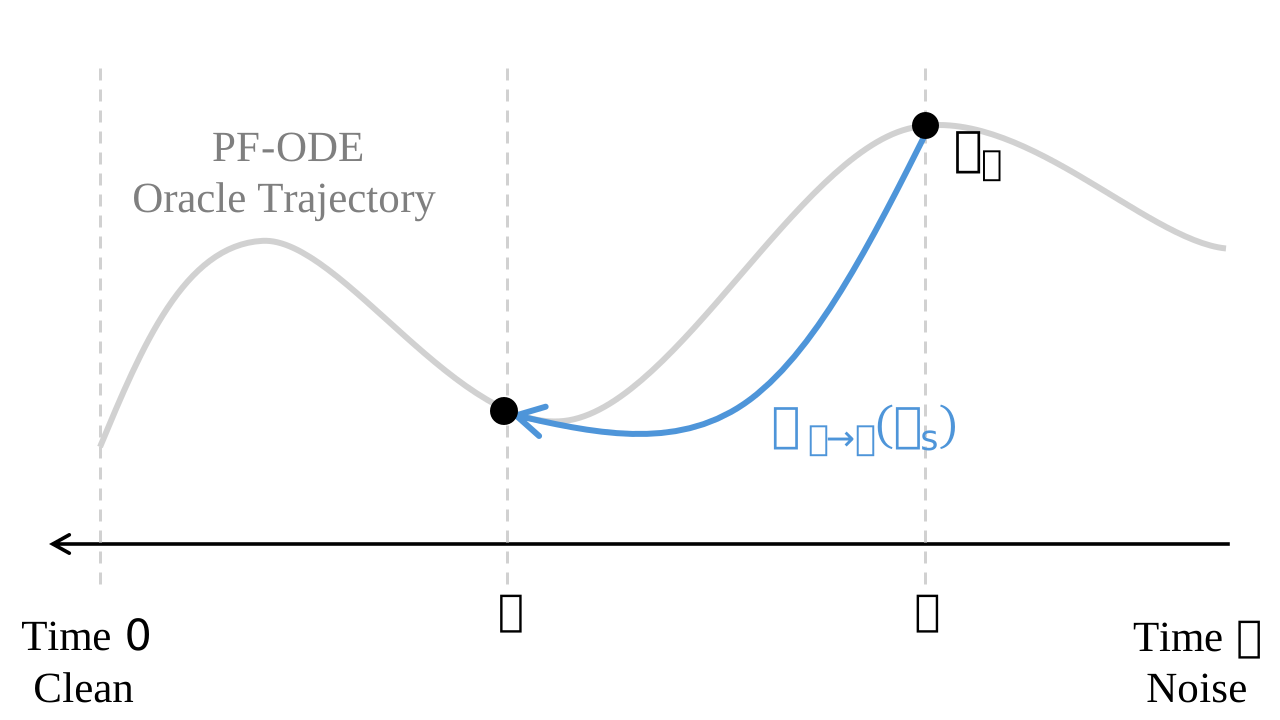
It answers one concrete question: starting from the current noisy state, where would the ideal dynamics place me at a later time? Standard samplers approximate this jump by chaining many tiny solver steps. A flow map model tries to learn the jump directly:
\[\mathbf{G}_\theta(\mathbf{x}_s,s,t)\approx \Psi_{s\to t}(\mathbf{x}_s).\]If we could query the true time-jump \(\Psi_{s\to t}\), the training story would be almost too simple: we would just regress to the oracle target. Concretely, we would sample a start time \(s\), an end time \(t\), draw a point \(\mathbf{x}_s\sim p_s\), and train a model \(\mathbf{G}_\theta\) to predict where that point should land after evolving from \(s\) to \(t\):
Here \(d(\cdot,\cdot)\) is simply a distance-like measurement (e.g., MSE), and \(w(s,t)\) is a time-weighting function. At the optimum, \(\mathbf{G}_\theta(\mathbf{x}_s,s,t)\) would match the oracle jump \(\Psi_{s\to t}(\mathbf{x}_s)\), so generation becomes a few large, accurate jumps rather than a long chain of tiny updates. In the most extreme case, we could even do one-step generation: first draw a prior sample \(\mathbf{x}_T \sim p_{\text{prior}}\), then map it straight to data with
\[\mathbf{G}_\theta(\mathbf{x}_T, T, 0).\]The snag is that \(\Psi_{s\to t}\) is not available in closed form. So the real design problem is: how do we create practical targets that still point toward the same oracle objective? The cleanest guiding structure is a property that true flow maps must satisfy.
Three Flow Map Families as Three “Handles” on the Same Oracle
Consistency Models (CM)
Since our end goal is a clean sample, CM fixes the terminal time at \(0\) and only focuses on the special jumps \(\Psi_{s\to 0}\). The ideal picture is straightforward: given a noisy state \(\mathbf{x}_s\), we would like a denoiser that directly returns where the true dynamics would land at time \(0\),
\[\mathbf{f}_\theta(\mathbf{x}_s,s)\approx \Psi_{s\to 0}(\mathbf{x}_s).\]If that oracle target were available, training would reduce to plain regression: sample a time \(s\), draw \(\mathbf{x}_s\sim p_s\), and penalize the mismatch (with a time weight \(w(s)\) and a distance-like measure \(d\)):
\[\mathcal{L}_{\text{oracle-CM}}(\theta) = \mathbb{E}_{s}\,\mathbb{E}_{\mathbf{x}_s\sim p_s} \Bigl[ w(s)\,d\bigl(\mathbf{f}_\theta(\mathbf{x}_s,s),\,\Psi_{s\to 0}(\mathbf{x}_s)\bigr) \Bigr].\]But in practice the oracle flow map \(\Psi_{s\to 0}\) is not something we can query. CM gets around this with one simple idea: self-consistency, which is really a flow-map property. Under standard ODE conditions, solutions are unique, so each initial state maps to a unique state at time $t$ by the flow map. Equivalently, flow maps must compose: going from \(s\) to \(0\) is the same as going from \(s\) to \(s-\Delta s\) and then from \(s-\Delta s\) to \(0\). As a result, any two states on the same trajectory, say \(\mathbf{x}_s\) and its backstep \(\Psi_{s\to s-\Delta s}(\mathbf{x}_s)\), must share the same endpoint at time \(0\). This is exactly what we exploit to replace the missing oracle target with a stop-gradient self-target \(\mathbf{f}_{\theta^-}\) computed from the nearby state closer to \(0\):
\[\Psi_{s\to 0}(\mathbf{x}_s) \;\approx\; \Bigl(\mathbf{f}_{\theta^-}(\Psi_{s\to s-\Delta s}(\mathbf{x}_s),\,s-\Delta s)\Bigr), \qquad \Delta s>0.\]So the whole method boils down to one practical step: how do we get a proxy \(\widehat{\mathbf{x}}_{s-\Delta s}\) for the inaccessible backstep \(\Psi_{s\to s-\Delta s}(\mathbf{x}_s)\)? There are two standard routes.
In distillation, we obtain the intermediate state by explicitly taking one reverse-time solver step driven by a pre-trained diffusion teacher. Concretely, starting from the current state \(\mathbf{x}_s\), we take
\[\widehat{\mathbf{x}}_{s-\Delta s} = \text{one solver step using the teacher, from } s \text{ to } s-\Delta s\]meaning that \(\widehat{\mathbf{x}}_{s-\Delta s}\) is the result of a single numerical update (e.g., Euler) from time \(s\) to \(s-\Delta s\) using the teacher diffusion model as the PF-ODE drift.
In from scratch training, we build the intermediate state directly from the forward-corruption rule: if \(\mathbf{x}_s\) was formed from the same clean sample \(\mathbf{x}_0\) and noise \(\boldsymbol{\epsilon}\), then we can reuse them to “rewind” to the slightly less-noisy time \(s-\Delta s\):
\[\widehat{\mathbf{x}}_{s-\Delta s} = \alpha_{s-\Delta s}\mathbf{x}_0 + \sigma_{s-\Delta s}\boldsymbol{\epsilon}.\]Once we have this proxy point, CM training becomes a fully practical regression against a stop-gradient self-target, replacing the inaccessible oracle map inside the original objective.
Consistency Trajectory Models (CTM)
CTM aims to learn the general flow map \(\Psi_{s\to t}\), but it does so with an Euler-flavored parameterization that makes the model behave like a solver step. The starting point is the flow map form
\[\Psi_{s\to t}(\mathbf{x}_s)=\mathbf{x}_s+\int_s^t \mathbf{v}(\mathbf{x}(u),u)\,\mathrm{d}u,\]and the key move is to rewrite this jump as a weighted blend of the input \(\mathbf{x}_s\) and a residual term:
\[\Psi_{s\to t}(\mathbf{x}_s) = \frac{t}{s}\,\mathbf{x}_s + \Bigl(1-\frac{t}{s}\Bigr)\,\mathbf{g}(\mathbf{x}_s,s,t), \qquad \mathbf{g}(\mathbf{x}_s,s,t) := \mathbf{x}_s+\frac{s}{s-t}\int_s^t \mathbf{v}(\mathbf{x}(u),u)\,\mathrm{d}u.\]This motivates a solver-like parameterization for the learned jump:
\(\mathbf{G}_\theta(\mathbf{x}_s,s,t) := \frac{t}{s}\,\mathbf{x}_s + \Bigl(1-\frac{t}{s}\Bigr)\,\mathbf{g}_\theta(\mathbf{x}_s,s,t),\) where \(\mathbf{g}_\theta\) is aimed to approximate the residual term \(\mathbf{g}(\mathbf{x}_s,s,t)\):
\[\mathbf{g}_\theta \approx \mathbf{g}.\]A nice side-effect is that the boundary condition comes for free. Plugging in \(t=s\) makes the mixing weight vanish, so
\[\mathbf{G}_\theta(\mathbf{x}_s,s,s)=\mathbf{x}_s,\]without any special constraint during training.
This parameterization is useful because the residual \(\mathbf{g}\) has a clean meaning in the small-step limit. As \(t\to s\), the flow-map integral collapses to an Euler-sized move, and \(\mathbf{g}(\mathbf{x}_s,s,t)\) approaches
\[\mathbf{g}(\mathbf{x}_s,s,t) = \mathbf{x}_s - s\,\mathbf{v}(\mathbf{x}_s,s) + \mathcal{O}(|t-s|).\]So learning \(\mathbf{g}\) does two jobs at once: it supports finite jumps \(s\to t\), and it also encodes the instantaneous drift through the infinitesimal limit. In particular, evaluating the network at “same time” gives a direct drift estimate,
\[\mathbf{v}(\mathbf{x}_s,s)\;\approx\;\frac{\mathbf{x}_s-\mathbf{g}_\theta(\mathbf{x}_s,s,s)}{s}.\]This is why \(\mathbf{g}_\theta(\cdot,s,s)\) matters in CTM: it acts as a local direction field that we can reuse to build short moves and form training targets.
CTM extends CM’s self-consistency into the natural flow-map principle called the semigroup property. The idea is simple: a long jump should agree with two shorter jumps stitched together. Concretely, for any intermediate time \(u\) between \(s\) and \(t\), the true flow maps satisfy
\[\Psi_{s\to t} \;=\; \Psi_{u\to t}\circ \Psi_{s\to u}.\]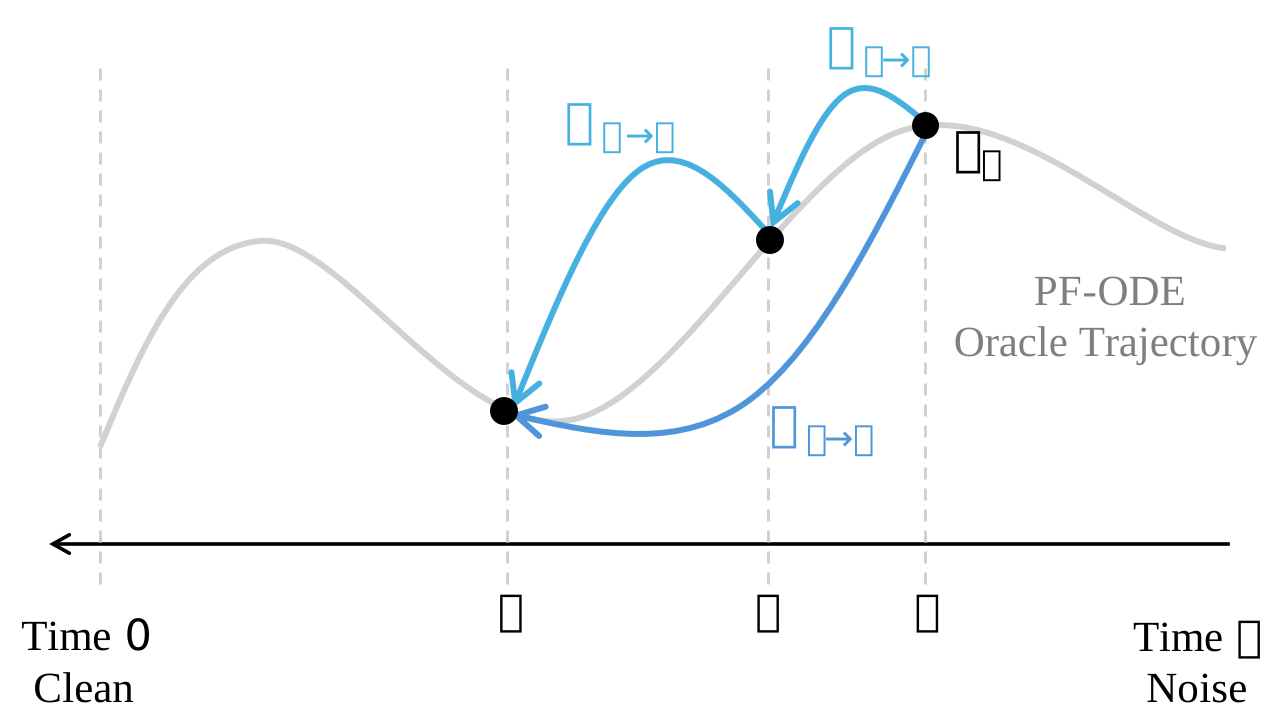
So CTM enforces the same idea with its learned map: a big jump should agree with two smaller jumps stitched at \(u\). Since the oracle maps are unavailable, CTM uses a stop-gradient self-target:
\[\Psi_{s\to t}(\mathbf{x}_s) \;\approx\; \mathbf{G}_{\theta^-}\Bigl(\Psi_{s\to u}(\mathbf{x}_s),\,u,\,t\Bigr),\]Finally, \(\Psi_{s\to u}(\mathbf{x}_s)\) can be approximated in two ways. In distillation, we compute it by running a few solver steps of a pre-trained diffusion teacher, starting from \(\mathbf{x}_s\) and integrating from time \(s\) to time \(u\):
\[\Psi_{s\to u}(\mathbf{x}_s) \approx \text{few solver steps using the pre-trained diffusion teacher, from } s \text{ to } u.\]In from scratch training, because \(\mathbf{g}_\theta(\cdot,s,s)\) reproduces the instantaneous drift of PF-ODE, we approximate \(\Psi_{s\to u}(\mathbf{x}_s)\) using CTM itself by rolling out a short self-teacher trajectory driven by the local drift implied by \(\mathbf{g}_\theta(\cdot,s,s)\):
\[\Psi_{s\to u}(\mathbf{x}_s) \approx \text{few solver steps using } \mathbf{g}_\theta(\cdot,s,s) \text{ from } s \text{ to } u.\]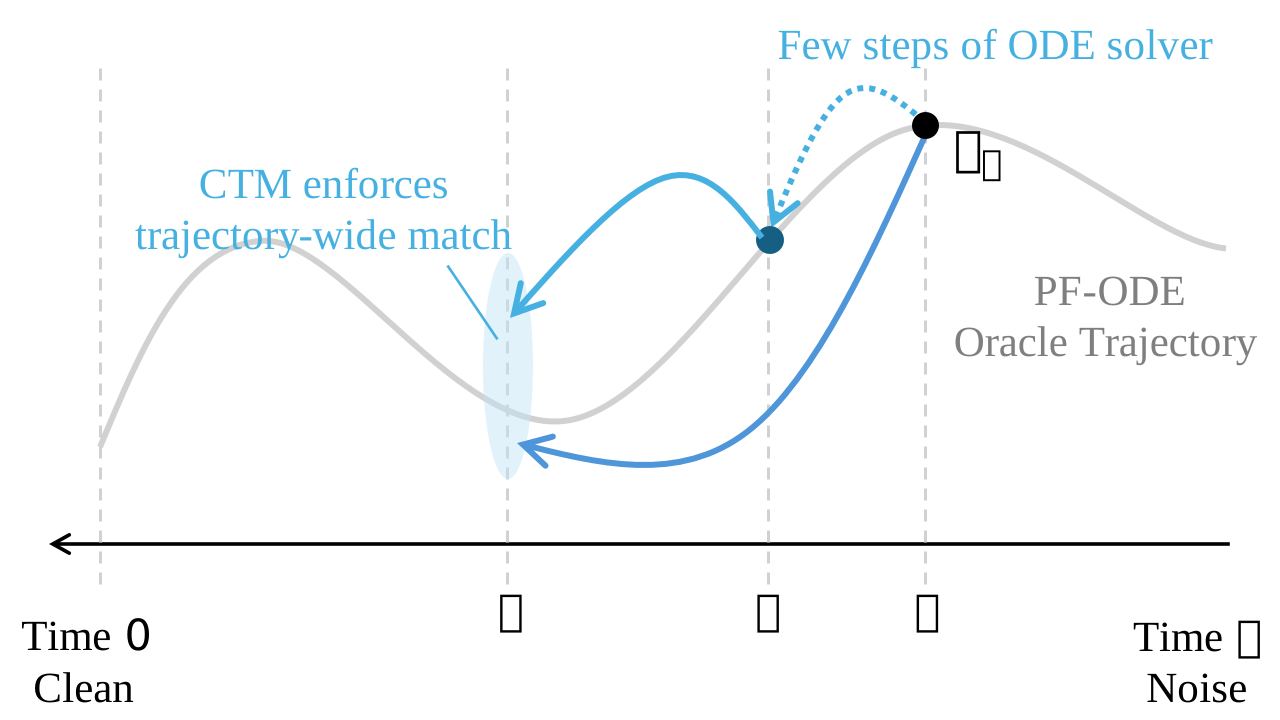
Mean Flow (MF)
MF keeps the same end goal of fast, accurate jumps for learning the general flow map \(\Psi_{s\to t}\), but it changes what the network predicts and how it is trained compared to CTM. Instead of outputting the endpoint jump directly, MF asks for an average integration over the interval, which we can view as the average slope of the flow map:
\[\mathbf{h}(\mathbf{x}_s,s,t) := \frac{1}{t-s}\int_s^t \mathbf{v}\bigl(\mathbf{x}(u),u\bigr)\,\mathrm{d}u, \qquad \mathbf{h}_\theta(\mathbf{x}_s,s,t)\approx \mathbf{h}(\mathbf{x}_s,s,t).\]Once we have this slope-like quantity, the jump is recovered by a simple reconstruction:
\[\Psi_{s\to t}(\mathbf{x}_s)\approx \mathbf{x}_s+(t-s)\,\mathbf{h}_\theta(\mathbf{x}_s,s,t).\]This is often easier to learn in practice: predicting an average drift is like learning a reliable slope that can be reused across different step sizes, instead of chasing a single fragile endpoint.
MF still needs supervision, so the question is how to build a usable target for \(\mathbf{h}\). The key is a small calculus fact. Starting from the definition
\[(t-s)\,\mathbf{h}(\mathbf{x}_s,s,t)=\int_s^t \mathbf{v}\bigl(\mathbf{x}(u),u\bigr)\,\mathrm{d}u,\]we differentiate both sides with respect to the start time \(s\). Two things then happen at once: the interval length changes, and the starting state \(\mathbf{x}_s\) itself slides along the trajectory with
\[\frac{\mathrm{d}}{\mathrm{d}s}\mathbf{x}_s=\mathbf{v}(\mathbf{x}_s,s).\]Putting these together yields an identity that expresses the average slope in terms of the instantaneous drift at \(s\), plus correction terms involving the derivatives of \(\mathbf{h}\):
\[\mathbf{h}(\mathbf{x}_s,s,t) = \mathbf{v}(\mathbf{x}_s,s) - (s-t)\Bigl( \mathbf{v}(\mathbf{x}_s,s)\,\partial_{\mathbf{x}} \mathbf{h}(\mathbf{x}_s,s,t) + \partial_{s} \mathbf{h}(\mathbf{x}_s,s,t) \Bigr).\]This is the MF identity handle: it turns an integral quantity into a local relation we can enforce during training.
Therefore, MF turns the MF identity into a practical training signal by freezing the derivative terms with a stop-gradient copy \(\mathbf{h}_{\theta^-}\). This gives us a usable proxy for the oracle mean flow \(\mathbf{h}\):
\[\mathbf{h}(\mathbf{x}_s,s,t) \approx \mathbf{v}(\mathbf{x}_s,s) - (s-t)\Bigl( \mathbf{v}(\mathbf{x}_s,s)\,\partial_{\mathbf{x}} \mathbf{h}_{\theta^-}(\mathbf{x}_s,s,t) + \partial_{s} \mathbf{h}_{\theta^-}(\mathbf{x}_s,s,t) \Bigr).\]MF still needs the oracle instantaneous drift \(\mathbf{v}(\mathbf{x}_s,s)\). In practice we plug in an estimate \(\widehat{\mathbf{v}}(\mathbf{x}_s,s)\) in one of two ways. With (i) distillation, a pre-trained diffusion model provides this velocity estimate. With (ii) from scratch training, we use the forward-corruption rule itself: if \(\mathbf{x}_s\) was generated from a clean sample \(\mathbf{x}_0\) using the same noise draw \(\boldsymbol{\epsilon}\), then the conditional mean path implies a closed-form velocity at time \(s\), giving a direct estimate
\[\widehat{\mathbf{v}}(\mathbf{x}_s,s)=\alpha_s'\mathbf{x}_0 +\sigma_s' \boldsymbol{\epsilon}.\]Putting these together yields MF’s final regression target, a fully practical proxy for \(\mathbf{h}(\mathbf{x}_s,s,t)\):
\[\mathbf{h}_{\theta^-}^{\text{tgt}}(\mathbf{x}_s,s,t) := \widehat{\mathbf{v}}(\mathbf{x}_s,s) - (s-t)\Bigl( \widehat{\mathbf{v}}(\mathbf{x}_s,s)\,\partial_{\mathbf{x}} \mathbf{h}_{\theta^-}(\mathbf{x}_s,s,t) + \partial_{s} \mathbf{h}_{\theta^-}(\mathbf{x}_s,s,t) \Bigr).\]How the Three Flow Map Models Relate
CTM contains CM as a special anchored case. If CTM always fixes the terminal time to \(t=0\), then it only needs to learn the maps \(\Psi_{s\to 0}\), which is exactly the CM setting.
More broadly, CTM and MF are mathematically related: they aim at the same oracle flow map, but they choose different parameterizations of the same jump. One way to see this is to rewrite the same map \(\Psi_{t\to s}(\mathbf{x}_t)\) in two equivalent-looking forms:
\[\Psi_{t\to s}(\mathbf{x}_t) = \frac{s}{t}\mathbf{x}_t + \frac{t-s}{t}\underbrace{\Bigl[\mathbf{x}_t+\frac{t}{t-s}\int_t^s \mathbf{v}(\mathbf{x}_u, u)\,\mathrm{d}u\Bigr]}_{\approx\,\mathbf{g}_\theta} = \mathbf{x}_t + (s-t)\underbrace{\Bigl[\frac{1}{s-t}\int_t^s \mathbf{v}(\mathbf{x}_u, u)\,\mathrm{d}u\Bigr]}_{\approx\,\mathbf{h}_\theta}.\]Beyond being mathematically related at the level of parameterization, CTM and MF objectives are also connected. We start from the raw squared error
\[\bigl\|\mathbf{G}_\theta(\mathbf{x}_t,t,s)-\Psi_{t\to s}(\mathbf{x}_t)\bigr\|_2^2.\]Using the CTM parameterization and a matching oracle decomposition, we have
\[\mathbf{G}_\theta(\mathbf{x}_t,t,s) = \frac{s}{t}\mathbf{x}_t+\frac{t-s}{t}\,\mathbf{g}_\theta(\mathbf{x}_t,t,s), \qquad \Psi_{t\to s}(\mathbf{x}_t) = \frac{s}{t}\mathbf{x}_t+\frac{t-s}{t}\Bigl(\mathbf{x}_t+\frac{t}{t-s}\int_t^s \mathbf{v}(\mathbf{x}_u,u)\,\mathrm{d}u\Bigr).\]The common base term \(\frac{s}{t}\mathbf{x}_t\) cancels, so the squared error factors into a scale term and a residual mismatch:
\[\bigl\|\mathbf{G}_\theta(\mathbf{x}_t,t,s)-\Psi_{t\to s}(\mathbf{x}_t)\bigr\|_2^2 = \Bigl(\frac{t-s}{t}\Bigr)^2 \Bigl\| \mathbf{g}_\theta(\mathbf{x}_t,t,s) - \Bigl(\mathbf{x}_t+\frac{t}{t-s}\int_t^s \mathbf{v}(\mathbf{x}_u,u)\,\mathrm{d}u\Bigr) \Bigr\|_2^2.\]To relate this to MF, we consider the following network re-parametrization
\[\mathbf{g}_\theta(\mathbf{x}_t,t,s):=\mathbf{x}_t-t\,\mathbf{h}_\theta(\mathbf{x}_t,t,s).\]Inside the norm, the \(\mathbf{x}_t\) terms cancel again, leaving an error purely in the averaged quantity:
\[\Bigl\| \mathbf{g}_\theta(\mathbf{x}_t,t,s) - \Bigl(\mathbf{x}_t+\frac{t}{t-s}\int_t^s \mathbf{v}(\mathbf{x}_u,u)\,\mathrm{d}u\Bigr) \Bigr\|_2^2 = t^2\Bigl\| \mathbf{h}_\theta(\mathbf{x}_t,t,s) - \Bigl(\frac{1}{s-t}\int_t^s \mathbf{v}(\mathbf{x}_u,u)\,\mathrm{d}u\Bigr) \Bigr\|_2^2.\]Multiplying by the prefactor gives
\[\bigl\|\mathbf{G}_\theta(\mathbf{x}_t,t,s)-\Psi_{t\to s}(\mathbf{x}_t)\bigr\|_2^2 = (t-s)^2 \Bigl\| \mathbf{h}_\theta(\mathbf{x}_t,t,s) - \Bigl(\frac{1}{s-t}\int_t^s \mathbf{v}(\mathbf{x}_u,u)\,\mathrm{d}u\Bigr) \Bigr\|_2^2.\]In words, CTM measures error in “residual coordinates” \(\mathbf{g}_\theta\), while MF measures error in “average-slope coordinates” \(\mathbf{h}_\theta\). The algebra shows these objectives are mathematically related, differing only by a time-dependent scaling of scale \(t^2\).
Flow map models all target the same underlying object: the oracle flow map \(\Psi_{s\to t}\) that moves probability mass along the ideal PF-ODE. What differs is which handle we use to learn that map without ever querying it directly. The punchline is that CM, CTM, MF are not three unrelated recipes. They are three ways to learn the same oracle flow map using different parameterizations and different self-contained training signals. In practice, this is exactly how we turn “many tiny solver steps” into “a few accurate jumps” while staying faithful to the same density-evolution story we started from: move particles, conserve probability, and learn the map that performs the transport.
Conclusion: One Story, Many Lenses, and the Road to Fast Generators
Modern diffusion models can look like a zoo of acronyms, but the underlying story is surprisingly simple. At heart, they are all ways to transport probability mass from a simple Gaussian distribution to the complicated data distribution progressively. Once you see generation as a moving cloud of particles, the math stops being mysterious: it is really just different forms of time-varying change-of-variables.
From there, variational based, score-based, and flow-based diffusions differ less than their names suggest. They all choose the same forward Gaussian snapshots and then ask the network to predict different but equivalent handles on the reverse-time dynamics. What makes training workable in all three cases is the same move: the conditional trick. We replace an intractable marginal target (reverse kernel / score / velocity under \(p_t\)) with a tractable conditional target under \(p(\mathbf{x}_t\mid \mathbf{x}_0)\), turning challenging problems into “solve a supervised regression problem”.
But diffusion’s classic payoff, high-fidelity samples, comes with a classic cost: iterative sampling. If we must integrate the reverse dynamics in many small steps, generation stays slow. Flow map models push the same diffusion template one step further: instead of learning infinitesimal updates and then integrating them, they aim to learn time-jumps of the PF-ODE directly. In other words, they try to approximate the map \(\Psi_{s\to t}\) itself, so we can replace long chains of tiny steps with a handful of large, accurate jumps. CM, CTM, and MF are three concrete “handles” on this idea: each enforcing underlying flow-map structures to manufacture practical targets when the oracle flow map is unavailable.
Stepping back, the big takeaway is optimistic: diffusion models are not a single method, but a principle for building generators from a prescribed forward path. Once we commit to “choose a forward corruption, then learn its reverse transport”, there is room for many designs that trade off stability, fidelity, and speed. Flow maps are one promising direction, but likely not the last word. The exciting open space is to keep the same clean backbone: we define a forward transport process, and change-of-variables tells us how the distribution moves. Then we look for new parameterizations and objectives, which make fast generation as reliable as the best step-by-step samplers.
Enjoy Reading This Article?
Here are some more articles you might like to read next: