Performative Prediction made practical
Performative Prediction studies settings where deploying a model induces a distribution shift in the data with the aim of building robust and good-performing models under these post-deployment effects. Most existing work in this area is theoretical and relies on strict assumptions to converge to those models, making the resulting techniques difficult to apply in practice and limiting their accessibility to the broader Machine Learning (ML) community. In this blog post, we use visualization techniques 1) to provide an intuitive explanation of Performative Prediction and 2) to extract practical insights for studying convergence when theoretical assumptions do not hold.
Deployed model = Happy ML engineer?
You are an ML engineer working at a bank. You build a model to grant loans by predicting whether an applicant is likely to default. The model performs extremely well on your test set. The company deploys it, and in the first weeks, everything looks great — the model performs just as expected. You receive congratulations, and you feel proud of a job well done.
But… a few months later, performance starts to drop. Repeat applicants have begun adjusting their financial profiles just enough to get approved. They have learned how to game your model. As a result, the reapplicants your system sees no longer resemble those in your training data. Simply by deploying your model, you have changed the data distribution. In other words, deploying your model has triggered a distribution shift.
Once an ML model is deployed, it undoubtedly has an effect in the real world. Yet, this effect has been largely overlooked in ML, as deployment is often the final step of the ML pipeline. If we want models to perform reliably in practice, post-deployment effects must be accounted for.
This scenario has been formalized in the field of Performative Prediction,
This formulation contrasts with the classical ML setup, where one assumes a fixed data distribution $\mathcal{Q}$. In Performative Prediction, however, each deployment of the model induces a shift in the data distribution. After this shift occurs, the model must be retrained, but the newly trained model, once deployed, triggers yet another distribution change. This creates an iterative feedback loop between model training and distribution shift, which is the defining characteristic of the performative setting.

Whereas the main objective in classical ML is to find a model that minimizes the risk under a fixed data distribution, Performative Prediction presents a more intricate challenge because the model itself affects the distribution. In this setting, one can seek a stable model that has the same risk before and after deployment, i.e., is robust to the distribution shift. One may also seek an optimal model, which is the model that produces the lower risk after deployment. We will formalize these notions later.
Published works in Performative Prediction have mainly adopted a theoretical perspective, relying on strict assumptions to ensure guarantees for the convergence of optimization algorithms to stable or optimal points. However, these assumptions significantly narrow the scope of problems that can be solved. This can be surprising, since the motivation of the field is intrinsically practical — it concerns what happens after a model is put into production. Another issue with this is that although Performative Prediction is now a well-recognized framework for studying the effects of deployment, its technical details remain relatively unknown to the broader ML community.
Through visualization, this blog post aims to make the technical details of performative prediction more accessible to the broader ML community and to provide insights to support more practical research that emerges directly from these visualizations. Specifically, our goals are:
-
To introduce Performative Prediction as a two-step iterative process, an intuitive interpretation that naturally reveals the structure of the optimization landscape, and to explain how this landscape can be visualized (Section Introduction).
-
To use the visualization to describe the two interest points of Performative Prediction (stable and optimal points) and reformulate them (Section Interest Points), and to visualize the trajectories of different optimization algorithms, developing intuition for why they converge (Section Optimization in Performative Prediction).
-
To show how this reformulation of the interest points can be practically used in experimental settings that fall outside the usual theoretical assumptions, illustrating their value in more realistic scenarios (Section Practical insights in experiments). As part of pushing Performative Prediction forward, we also reflect on the future of its practical research, hoping to spark a discussion within the community about its current limitations and emerging opportunities (Section Future directions of the field).
To support practical research, we also make available PerformativeGym, a small library that implements the main algorithms used in Performative Prediction.
Introduction: Performative Prediction is a two-step iterative process
In order to characterize the feedback loop between the model and the data distribution, Performative Prediction can be described as an iterative process. Before the process begins, we have an initial data distribution, which we use to train the first model $\theta^{(1)}$. Some time after deployment, the world will react to the model, causing a distribution shift. The data will then follow a new probability distribution given by $\mathcal{D}(\theta^{(1)})$. In each subsequent iteration, we 1) obtain a model \(\theta^{(t+1)}\) trained on the data distribution \(\mathcal{D}(\theta^{(t)})\) and 2) deploy it, causing the distribution to shift to \(\mathcal{D}(\theta^{(t+1)})\). This distribution shift is inherent to model deployment, i.e., it happens because of the mere deployment of the model and is unavoidable.
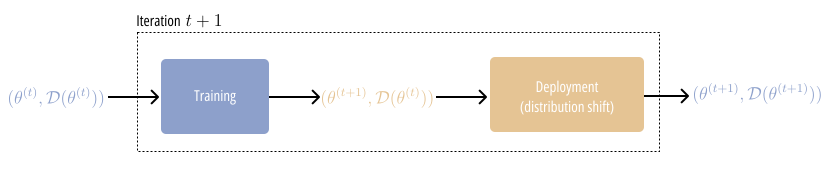
Classical ML reports the performance of the model after training. But this is not enough in Performative Prediction due to the distribution shift. The fact that the environment reacts to the model makes it difficult to evaluate its performance.
How to measure the performance of the model, then?
In Performative Prediction, we can consider two risks when evaluating a model $\theta^{(t+1)}$: the risk of the model under the learned distribution $\mathcal{D}(\theta^{(t)})$, which reflects its training performance; and the risk of the same model under the new distribution $\mathcal{D}(\theta^{(t+1)})$, which captures its performance after the distribution shift and is ultimately the more informative quantity. The decoupled performative risk $\mathcal{DPR}(\cdot, \cdot)$ allows us to measure both. For clarity, we will introduce the notation \(\theta_M\) to refer to the parameters of the model we want to evaluate and \(\theta_D\) to refer to the parameters of the model that defines the data distribution $\mathcal{D}(\theta_D)$.
\[\mathcal{DPR}(\theta_D, \theta_M) := \mathbb{E}_{(x,y) \sim \mathcal{D}(\theta_D)} \big[\ell(\theta_M; x, y)\big],\]where \(\ell(\theta_M; x, y)\) is the loss function of the model \(\theta_M\) on the data sample \((x,y)\).
Ultimately, we are, however, mostly interested in the risk of the model on the distribution induced by its own parameters, since this captures its actual post-deployment performance. This risk is referred to as the performative risk and is defined as follows:
\[\mathcal{PR}(\theta) := \mathcal{DPR}(\theta, \theta) = \mathbb{E}_{(x,y) \sim \mathcal{D}(\theta)} [\ell(\theta; x, y)].\]Visualizing the decoupled risk
All published works center their analysis on the performative risk, as it measures the performance after the shift. However, as we saw in the last section, the performative risk cannot measure performance right after training. To have a full understanding of the optimization dynamics, we need to take a look beyond the performative risk.
To do this, we can visualize the decoupled performative risk. Throughout this blog post, we use this visualization to gain insights into questions like: what are the practical differences between a stable and an optimal point? How do certain algorithms converge? Or how can we have a sense of convergence if theoretical assumptions are not met?
Before introducing the visualization, let us present another example: now imagine that you are an ML engineer in a retail company in charge of training a model that sets the price of the products. The price of the products will undoubtedly affect the demand of the customers to buy the product. Thus, we can formalize this problem as Performative Prediction. We consider a simplified version of this setup, modifying the original example by Izzo et al.
Note that in this example, the model $\theta$ is just the price deviation of the products from the baseline price, and the output of the model can be considered $\theta_0 + \theta$. As one wants to maximize the total revenue $(\theta_0 + \theta)^T z$, then the loss function is simply $\ell(z;\theta) = -(\theta_0 + \theta)^T z$ and there is no need to have labels.
With the decoupled risk visualization, it is easier to understand the optimization dynamics!
Consider the case where your retailer company only sells one product, $z \in \mathbb{R}, \theta \in [-5,5]$. You train an initial model $\theta^{(1)}$ on the initial distribution $\mathcal{D}(\theta^{(0)})$. Your risk is then $\mathcal{DPR}(\theta^{(0)}, \theta^{(1)})$. After deployment, the distribution changes to $\mathcal{D}(\theta^{(1)})$. Your risk is then $\mathcal{PR}(\theta^{(1)}) = \mathcal{DPR}(\theta^{(1)}, \theta^{(1)})$. This pull towards the diagonal cross-section, i.e., the performative risk as $\mathcal{DPR}(\theta, \theta) = \mathcal{PR}(\theta)$, happens again at every step, creating a repeated cycle of updating the model and observing the induced distribution shift.
During the optimization step, the data distribution does not change. Therefore, the optimization happens in a vertical section of the plane, where $\theta_D$ is fixed. We will call this section of the plane the fixed-distribution cross-section. Its corresponding risk is:
\[\mathcal{DPR}(\theta_D, \theta_M)\big|_{\theta_D = \theta^{\prime}_D} = \mathcal{R}_{\theta^{\prime}_D} (\theta_M) = \mathbb{E}_{(x,y) \sim \mathcal{D}(\theta^{\prime}_D)} \big[\ell(\theta_M; x, y)\big] .\]This can be seen as a marginalization of the decoupled performative risk. Thus, $\theta^{\prime}_D$ is a fixed value. Note that in classical ML, you operate within just one single fixed-distribution cross-section, without accounting for the richer space in which the system actually evolves after model deployment.
Interest points of Performative Prediction
One natural solution to the problem of Performative Prediction is deploying a model that — after it has affected the data distribution — does not require retraining, i.e., a model robust to the distribution shift. This model will be optimal for the distribution induced by itself. This point is called performatively stable:
\[\theta_{ST} = \operatorname*{argmin}_{\theta} \mathbb{E}_{(x,y)\sim \mathcal{D}(\theta_{ST})}[\ell(\theta;x, y)]\]and it can be seen as the fixed point solution of the function \(\theta^*_M(\theta_D) := \operatorname*{argmin}_{\theta_M} \mathcal{DPR}(\theta_M, \theta_D)\).
However, this solution is not optimal for the closed-loop interaction between the data and the model, i.e., it is not the minimum of the performative risk. The minimum of the performative risk is called the performative optimum:
\[\theta_{OP} = \operatorname*{argmin}_{\theta} \mathcal{PR}(\theta) = \operatorname*{argmin}_{\theta} \mathbb{E}_{(x,y)\sim \mathcal{D}(\theta)}[\ell(\theta;x, y)]\]The new visualization inspires a redefinition of the interest points
The new visualization allows for visualizing the difference between robustness (stable point) and optimality (optimum point) more clearly. Keep in mind they are interest points of the performative risk, and therefore, they lie in the diagonal section of the plane, where $\mathcal{DPR}(\theta, \theta) = \mathcal{PR} (\theta)$.
If the minimum in one fixed-distribution cross-section \(\theta^* = \operatorname*{argmin}_{\theta_M} \mathcal{R}_{\theta_i}(\theta_M)\) is the same model that induced the distribution ($\theta^* =\theta_i$), then $\theta_i$ is stable.

In the pricing example, $\theta_1$ is stable because the fixed-distribution risk \(\mathcal{R}_{\theta_1}(\theta_M)\) is flat; consequently, every $\theta_M \in \Theta$ is a minimizer of $\mathcal{R}_{\theta_1}(\theta_M)$, including $\theta_1$. On the other hand, $\theta_2$ is not a stable point because \(\theta_2 \ne \operatorname*{argmin} \mathcal{R}_{\theta_2}(\theta_M)\).
Therefore, the gradient in the direction of the fixed-distribution cross-section has to be zero for the point to be stable. We abuse notation and use $\nabla_M$, $\nabla_D$ to refer to $\nabla_{\theta_M}$, $\nabla_{\theta_D}$, respectively.
Proposition 1. If $\theta_{ST}$ is a stable point of the performative risk $\mathcal{PR}(\theta)$, then
\[\nabla_M\,\mathcal{DPR}(\theta_\mathit{ST}, \theta_\mathit{ST}) = 0~.\]On the other hand, the optimal point of the performative risk is the minimum of the performative risk, i.e., the diagonal section.

Thus, the gradient in the diagonal direction has to be zero.
Proposition 2. If $\mathcal{PR}(\theta)$ is strictly convex, then $\theta_{OP}$ is an optimal point of the performative risk $\mathcal{PR}(\theta)$ if and only if
\[\nabla_M\,\mathcal{DPR}(\theta_\mathit{OP}, \theta_\mathit{OP}) + \nabla_D\,\mathcal{DPR}(\theta_\mathit{OP}, \theta_\mathit{OP}) = 0~.\]In Section Practical insights in experiments, we will show how these reformulations can be used to get practical insights about convergence in experiments where strict theoretical assumptions do not hold.
How to reach them? Optimization in Performative Prediction
Algorithms that converge to the stable point
The Performative Prediction literature started out by focusing on how to find the stable solution, as it is a more tractable optimization problem. The first algorithms were based on just retraining the model after sampling from the new distribution. The process of these algorithms can be summarized as follows:
- Get the data samples of the distribution induced by \(\theta^{(t)}\): \((x,y)\sim \mathcal{D}(\theta^{(t)})\)
- Train the model on those data samples, considering the distribution fixed: \(\theta^{(t)} \rightarrow \theta^{(t+1)}\)
- Deploy the model, causing a new distribution shift: \(\mathcal{D}(\theta^{(t)}) \rightarrow \mathcal{D}(\theta^{(t+1)})\)
If the model is fully optimized at each step, the algorithm is called Repeated Risk Minimization (RRM). Whereas if only one gradient descent step is performed, it is called Repeated Gradient Descent (RGD).
In the founding paper of Performative Prediction, Perdomo et al.,
where $\mathcal{W}(\cdot, \cdot)$ is the Wasserstein distance of the two distributions. $\varepsilon$ can be understood as the performative effect. It is a measure of how much performativity there is in the example. When $\varepsilon=0$, then $\mathcal{D}(\theta_1) = \mathcal{D}(\theta_2)$ and we are in the classical ML setup.
With our visualization, it is quite intuitive to see why the algorithms converge. Recall that a fixed-distribution cross-section has a static distribution, $\mathcal{D}(\theta^{\prime}_D)$, where $\theta^{\prime}_D$ is the model that generates the fixed distribution. Therefore, if $\ell(\theta_M; x,y)$ is strongly convex in $\theta_M$, then the fixed-distribution risk \(\mathcal{R}_{\theta^{\prime}_D}(\theta_M) = \mathbb{E}_{\mathcal{D}((x,y) \sim \theta^{\prime}_D)}[\ell(\theta_M;x,y)]\) is also strongly convex since the expectation will preserve convexity.
Consequently, each cross-section is strongly convex (i.e., they have a global minimum), consecutive cross-sections vary smoothly, and the optimizer moves across them. Because the diagonal covers all the domain of $\theta$, eventually, during this process, the minimizer of some fixed-distribution cross-section will be within the diagonal—i.e., it will coincide with the model that generates that very distribution. At that point, the update becomes self-consistent, and the algorithm reaches a stable point.
Note that these algorithms do not use the information from the distribution map when training the model. They just use the data sampled from the shifted distribution. This distribution is considered to be static. Although it is very easy to apply them in practice (wait until the distribution shifts, observe new data samples, and retrain), they do not find the optimal solution, as they do not use explicit information of the distribution map while retraining the model. In these initial algorithms, the only guarantee of optimality is that the stable point might lie close to the optimal point under certain conditions, which are even more strict than the convergence to the stable point.
Algorithms that converge to the optimal point
Later, the literature started focusing on how to find the optimal solution directly. This point is more interesting, as it is the minimum of the performative risk. The most immediate idea is to apply gradient descent to the performative risk; this algorithm is called Performative Gradient Descent (PerfGD). The key step here is to calculate the performative gradient:
\[\nabla_{\theta} \mathcal{PR}(\theta) = \nabla_{\theta} \mathbb{E}_{(x,y) \sim \mathcal{D}(\theta)} [\ell(\theta; x, y)]~.\]This gradient is difficult to calculate due to the dependency of the data distribution on the model parameters in the expectation.
- REINFORCE
: uses the fact that the gradient of the likelihood of a random variable is the same as the likelihood times the gradient of the log likelihood $\nabla_{\theta} p_{\mathcal{D}(\theta)}(z) = p_{\mathcal{D}(\theta)}(z)\nabla_{\theta}\log p_{\mathcal{D}(\theta)}(z)$: \(\begin{align} \nabla_\theta \mathcal{PR}(\theta) &= \nabla_\theta \int \ell(\theta;z) p_{\mathcal{D}(\theta)}(z) dz \nonumber \\ &= \int \frac{\partial \ell(\theta;z)}{\partial \theta} p_{\mathcal{D}(\theta)}(z)dz + \int \ell(\theta;z) \frac{\partial p_{\mathcal{D}(\theta)}(z)}{\partial \theta}dz\nonumber\\ & = \int \frac{\partial \ell(\theta;z)}{\partial \theta} p_{\mathcal{D}(\theta)}(z)dz + \int \ell(\theta;z) \frac{\partial \log p_{\mathcal{D}(\theta)}(z)}{\partial \theta} p_{\mathcal{D}(\theta)}(z)dz \nonumber \\ &=\mathbb{E}_{z \sim \mathcal{D}(\theta)} \left[\frac{\partial \ell(\theta;z)}{\partial \theta} \right] + \mathbb{E}_{z \sim \mathcal{D}(\theta)} \left[ \ell(\theta;z)\frac{\partial \log p_{\mathcal{D}(\theta)}(z)}{\partial \theta} \right] \nonumber\\ &=\mathbb{E}_{z \sim \mathcal{D}(\theta)} \left[\frac{\partial \ell(\theta;z)}{\partial \theta} + \ell(\theta;z)\frac{\partial \log p_{\mathcal{D}(\theta)}(z)}{\partial \theta} \right] \end{align}\) - Reparametrization trick
: uses a deterministic function that is dependent on a base distribution and encodes the transformation caused by a parameter. Therefore, the expectation depends on the base-distribution only. In the case of Performative Prediction, this is achievable by defining a base distribution $\mathcal{D}_o$ that captures the samples before performativity and a push-forward model that defines the transformation of each sample due to performativity $z = \varphi(z_o, \theta)$. We can then use the multivariate chain rule to calculate the performative gradient: \(\begin{align} \nabla_\theta \mathcal{PR}(\theta) &= \nabla_\theta \mathbb{E}_{z \sim \mathcal{D}(\theta)} \big[ \ell(\theta;z)\big] \nonumber \\ & = \nabla_\theta \mathbb{E}_{z_o \sim \mathcal{D}_o} \big[ \ell(\theta; \varphi(z_o, \theta))\big] \nonumber \\ &= \mathbb{E}_{z_o \sim \mathcal{D}_o} \Big[ \nabla_\theta \ell(\theta; \varphi(z_o, \theta))\Big] \nonumber \\ &= \mathbb{E}_{z_0 \sim \mathcal{D}_0} \left[ \left.\frac{\partial \ell(\theta;z)}{\partial z}\right|_{z=\varphi(z_0; \theta)} \frac{\partial \varphi(z_0;\theta)}{\partial \theta} + \left. \frac{\partial \ell(\theta;z)}{\partial \theta}\right|_{z=\varphi(z_0; \theta)} \right] \end{align}\)
The proof of convergence of PerfGD is more complex; it requires to studying the convexity of $\mathcal{PR}(\theta)$. Due to the dependency on $\theta$ of the expectation, it is not enough that $\ell(\theta;z)$ is convex. Miller et al.
Note that this algorithm still does not move directly along $\mathcal{PR}(\theta)$. Instead, it still takes a step in the fixed-distribution direction first (in the optimization step) and only afterwards returns to the diagonal (when the distribution shift happens). What does change is that the optimization step now incorporates information about how the distribution responds to $\theta$. In fact, the gradient decomposes as:
\[\nabla \mathcal{PR}(\theta)= \nabla_D \mathcal{DPR}(\theta_D, \theta_M) + \nabla_M \mathcal{DPR}(\theta_D, \theta_M),\]so the update reflects both the direct model gradient and the distribution-induced component.
Visualization of the algorithms in the decoupled risk landscape
The figure illustrates the convergence behavior of the different algorithms for the pricing example in the decoupled risk landscape. We keep the same color scheme from previous visualizations to facilitate comparison and interpretation.
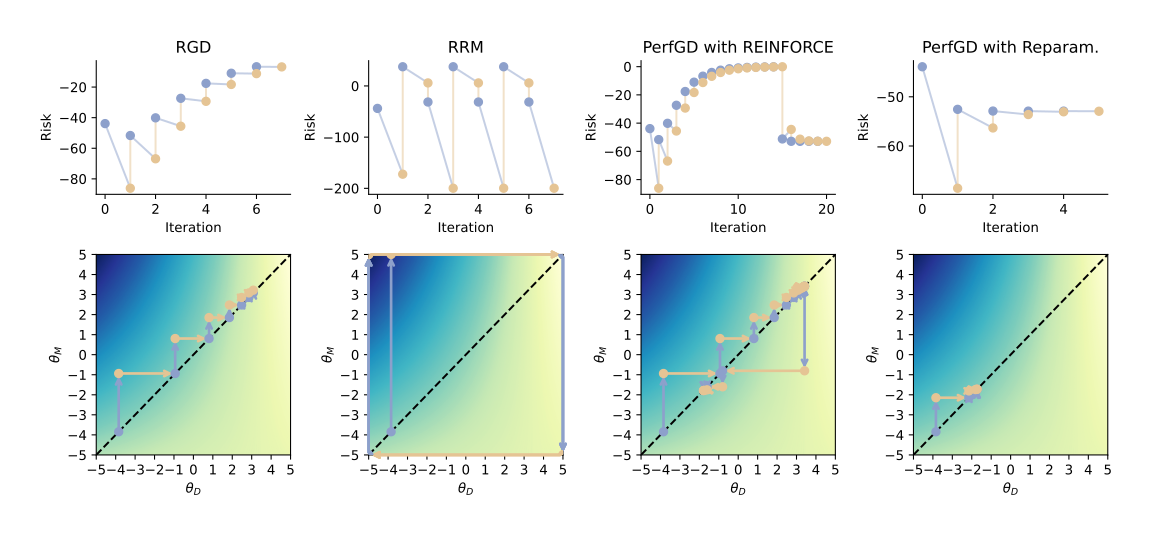
RGD converges to the stable point, whereas RRM does not converge at all. The reason is that the loss $\ell(\theta;z)$ is convex but not strongly convex (see Proposition 3.6 of Perdomo et al.
Practical insights in real-world experiments
One of the restrictive assumptions for the convergence of Performative Prediction algorithms is the convexity of the loss function $\ell(\theta; x,y)$ with respect to the model weights.
In classical ML, under these conditions, the focus is typically shifted from convergence to the global minimum to find solutions heuristically that perform well. In fact, it has been widely studied in Deep Learning that a flat minimum can generalize well (not necessarily only a global minimum)
In this section, we use the gradients to show convergence in one experiment with high-dimensions and another one with a neural network as a model.
Let’s extend the pricing example to $d=100$ products. Now, $z \in \mathbb{R}^{100}, \theta\in[-5,5]^{100}$. The stable point ($\theta_{ST} = \frac{z_0}{\epsilon}$) and optimal point ($\theta_{OP} = \frac{z_0 - \varepsilon \theta_0}{2\epsilon}$) can be computed in closed-form.
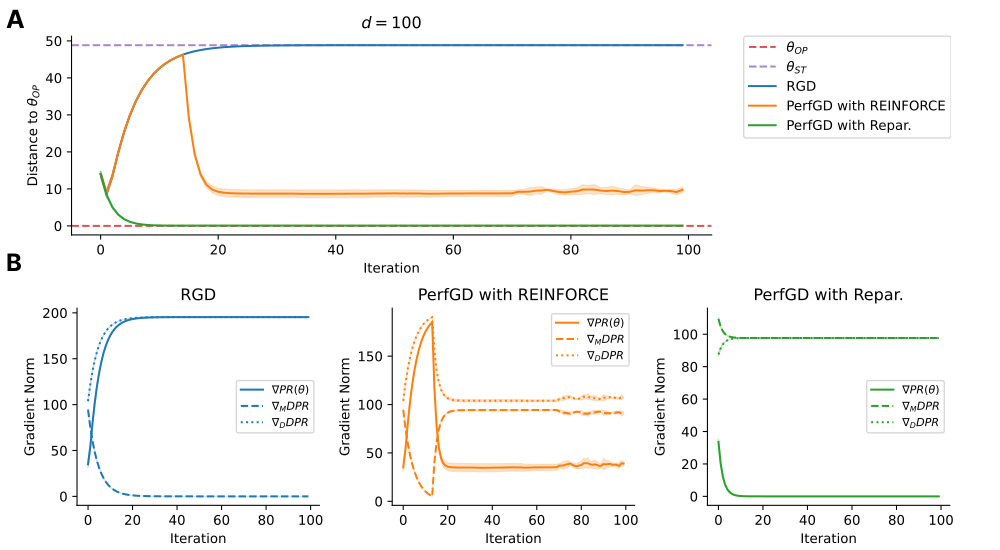
To check how good the algorithms perform, we plot the distance to the optimal point. As expected, RGD only converges to the stable point, whereas PerfGD converges to the optimal. The REINFORCE variant of PerfGD includes a warm-up phase that effectively corresponds to retraining, which explains why its behavior is similar to RGD during the initial iterations. However, it ultimately fails to match the performance of the variant based on the reparameterization trick. We conjecture that the REINFORCE variant struggles in the high-dimensional setting because the variance of the REINFORCE estimator becomes too large to provide reliable gradient estimates. Based on our experience with both versions of PerfGD, we recommend using the reparametrization one whenever possible. We can see how the gradients confirm the convergence to the stable or optimal point. In RGD, only $\nabla_M \mathcal{DPR}$ goes to zero. In contrast, with PerfGD, neither of $\nabla_M \mathcal{DPR}$ nor $\nabla_D \mathcal{DPR}$ goes to zero, but their sum $\nabla \mathcal{PR}$ does because both of the components go in opposite directions.
Let’s also consider the bank loan example. We use the real-world dataset Give me some credit
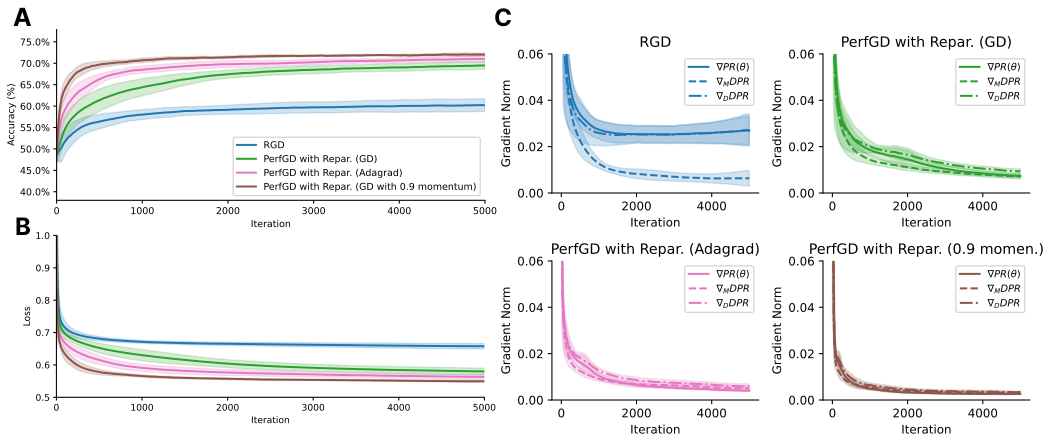
Inspired by classical ML, we have added momentum to GD and used Adagrad as an optimizer. These techniques work heuristically to find good minima but have never been used in Performative Prediction. By looking at the gradients, we can analyze if they also work in Performative Prediction.
In this case, RGD converges to a stable point because only $\nabla_M \mathcal{DPR}(\theta_D, \theta_M)$ goes to zero. In contrast, all variants of PerfGD converge to a flat minimum because both $\nabla_M \mathcal{DPR}(\theta_D, \theta_M)$ and $\nabla_D \mathcal{DPR}(\theta_D, \theta_M)$ approach zero, thereby making $\nabla \mathcal{PR}(\theta)$ vanish. Using Adagrad or momentum speeds up the convergence dynamics. We cannot assert that this minimum is the performatively optimal point; we can only say that it is a flat stationary point. However, as discussed, this distinction is not crucial in practice: $\mathcal{PR}(\theta)$ is not strongly convex, thus we cannot say much about the global optimum, and prior results have shown that flat minima often perform well in real-world settings.
We believe that these new insights about the gradients of the decoupled risk are especially relevant in Performative Prediction to account for realistic scenarios with non-convex losses or no sensitivity guarantees on the distribution map.
To open a discussion on future directions of the field
We could conclude the blog post at this point. We have clarified why Performative Prediction is a relevant problem, introduced the core ideas of the field to a broader ML audience, and proposed metrics that can be directly applied in practical scenarios. However, the blog post format gives us space to reflect more broadly. In particular, we would like to use this opportunity to discuss the challenges ahead and outline what we see as meaningful next steps for practical research on Performative Prediction within the community.
Performative Prediction is, in many ways, a cursed field. Its motivation is fundamentally practical—models deployed in the world influence the data they will later learn from—yet practical research faces severe, structural limitations. To converge to the truly relevant performative optimum, we need information about the distribution map $\mathcal{D}(\theta)$, which governs how the environment shifts in response to a model’s predictions. Recall that Performative Prediction is a two-step iterative process: (1) train a model, (2) deploy it and observe the induced distribution shift. Most existing works focus on the first step, proposing algorithms that optimize under the assumption that either (a) the distribution map is known, or (b) it can be reliably estimated from samples. The core barrier to practical Performative Prediction is that in realistic settings, we have very limited visibility into how deployment shifts the data. That is why simple iterative retraining is often preferred in practice: it is more robust. It continually adapts to the most recent data without relying on an explicit model of distributional feedback. Estimating $\mathcal{D}(\theta)$ from samples alone is difficult or ethically constrained. Once a model is deployed, it is typically fixed, and deploying multiple models across different populations solely to collect data for estimation would be highly unethical.
While the optimal point achieves a lower risk than the stable point, the algorithms used to reach it rely on computing $\nabla_D \mathcal{DPR}(\theta_D, \theta_M)$, which requires knowledge of the induced distribution $\mathcal{D}(\theta)$. In large-scale systems such as search, advertising, and recommendation, however, this distribution is influenced by many external factors, leading to highly non-stationary environments that are difficult to model accurately. As mentioned before, in practice,
We argue that there are two main directions for the field of practical Performative Prediction to advance: 1) developing techniques to estimate $\mathcal{D}(\theta)$ considering the previously stated limitations or 2) focusing on outcome performativity, which frames the distribution map as a function of the inputs and the model’s predictions.
On the one hand, regarding the estimation of the distribution map, Miller et al.
On the other hand, outcome performativity
Crucially, it is often possible to collect data that reflects this effect, because the outcome is shaped by decision rules already in operational use. For this reason, we argue that Performative Prediction research may be more practically impactful when focused on outcome performativity. The ethical and feasibility limitations discussed above are significantly reduced, and the feedback loop can be studied in realistic, deployment-aligned scenarios.
Conclusion
Now, imagine you are an ML engineer working in the company of your dreams. You were hired some time ago, and you are excited because you worked on the next big thing. The soon-to-be-released model works amazingly well in your test sets — AGI is just around the corner! But… have you considered the effects that this model will have on the data distribution? If the internet is populated with text and images created by your model… You might not be able to train the next model.
Are we taking enough care in post-deployment effects? It seems that it is crucial, and retraining is not enough…
Acknowledgements
We thank X. de Juan, P. Diego, R. González, X. Benavides, and M. Koch for their helpful comments on the manuscript. We also thank the reviewers for their thoughtful and constructive feedback.
This project has been directly supported by the Basque Government (BERC 2022–2025 and IT2109-26); by the Spanish Ministry of Science and Innovation (MICIN/AEI/10.13039/501100011033) through project PID2022-137442NB-I00 and the BCAM Severo Ochoa accreditation (PRE2022-102655 and CEX2021-001142-S); and by the European Union’s Horizon Europe Programme (Grant Agreement No. 101120763 – TANGO and No. 101123000 – act.AI). The views and opinions expressed are those of the author(s) only and do not necessarily reflect those of the funding bodies.
PLACEHOLDER FOR ACADEMIC ATTRIBUTION
BibTeX citation
PLACEHOLDER FOR BIBTEX